
Scripture References: Matthew 2:1–18
3720 AM (40 BCE) – BETTER TO BE HIS PIG
Hyrcanus was tending his duties as high priest. Nearly a quarter of a century older, he no longer had the same fears and insecurities he did when he was younger. What was there to be insecure about, anyway? After all, when one is high priest, one is supposed to be high priest for life. And with Rome at the helm, what worries did he have, really? What needs went unfulfilled?
Jerusalem was bustling, and people were happy throughout all Judea. Technically, he was still king, but it was never a position he wanted. He liked being the Ethnarch, which was more an administrative role, anyway. And the tribute really wasn’t that bad. It certainly could get complicated if someone could not pay their share, but Hyrcanus did not like to think about that.
Mostly, Jerusalem was certainly in a better state than it would be if Rome decimated it. Besides all that, Hyrcanus had his good friend, Antipater, who helped to be that link to Rome for the weightier matters of state. Antipater really was the father Hyrcanus never had; so selfless, tirelessly working for the betterment of Israel. As far as Hyrcanus was concerned, there had never been a foreigner, an Edomite of all people, who put Israel’s needs above his own ambitions.
In fact, it was Antipater who came to Hyrcanus with the most troubling news.
“I don’t understand,” Hyrcanus blurted. “I thought Pompey was one of the good guys.”
“Well,” Antipater explained, as he poured them both some tea, “that has mostly been true to a large degree. It’s just as of late, the squabbles between Pompey and Caesar have gotten out of hand. And, well, frankly, I am concerned what it will mean for Judea.”
“Ah,” Hyrcanus said, almost in relief, “the weightier matter of state.”
“Yes,” Antipater concurred with a large clap of his hands. “You do understand. The weightier matters of state. And it’s my job, my responsibility, to make sure that Judea is positioned politically to be in alignment with and to curry favor with the one most likely to come out on top. And that is definitely looking to be Caesar.”
“But Pompey did so much for us, for me, and, uh, for you, even. He’s been loyal to us. I feel like we are betraying him.” The words felt heavy to Hyrcanus.
“Perhaps,” Antipater admitted. “Perhaps. It’s a risk that it could be perceived that way, I suppose. But everything is a risk. Waking up in the morning and walking down the streets could be a risk. You could be mowed down by a pack of wild horses, or…”
“…or a pack of wild Romans,” Hyrcanus quipped.
Antipater laughed. “Quite right! Quite right! So, you see, we just need to make sure that we are running with the right pack of wild Romans, and the rest, well, we can leave that to Adonai. Does that help?”
Hyrcanus emoted warmly. “That … that really does help! Thank you, Antipater; you really are like the father I never had.”
Antipater stood and gestured to the door, inviting Hyrcanus to move on with his day. “And you are the son I never had!”
Hyrcanus vigorously shook Antipater’s hand, hugged him quickly, smiled, and then left. As Antipater shut the door, he could sense his wife, Cypros, standing, leering. Her sigh betrayed her contempt.
“You still use that old line with him?” she criticized.
“Yeah,” Antipater responded as he turned to her, “because it works, and he believes it. Do you think we would be where we are if I had told him the truth? That I actually have a son?”
“Or that you have four sons,” his wife mused.
“Or that I have four sons,” he repeated back to her.
Their eyes met. He understood, and so did she. Hyrcanus was merely a puppet, a stepping stone, an object to be used to ascend, and quite literally nothing more.
☼ ☼ ☼
The “prison” that Aristobulus and his family dwelt in was a kind of housing compound. It was above ground and clean, with tall walls and only one way in or out. And it was staffed by two guards, one on the inside and the other on the outside. They were changed out fairly regularly so as not to have too much familiarity with the family, and they never responded to questions or conversation. They would stand guard and nothing more.
Their food was provided by Rome, which included some meats and vegetables, along with bread and a cheap, watered-down wine.
Aristobulus would often miss the wine from Israel, as he did this morning when he sat down to breakfast with his family. At least they were together. At least they were safe. Naturally, vengeance would be theirs. It was a topic of nearly every meal. And at least they—
Aristobulus looked around the table, noticing the absence of two of his sons.
“Where are Alexander and Antigonus?” he asked aloud.
Everyone started looking around as if also noticing for the first time.
“Alexandra, would you check their rooms and see what mischief they are getting into?” Aristobulus asked, unusually politely.
With a sigh and a huff, Alexandra pushed herself loudly from the table and disappeared into the compound. Minutes later, she returned.
“They are not in their rooms, okay? Can we eat now? Like, really?”
Aristobulus was not amused. He stood up and quickly walked the entire compound. They were gone. There were no signs of them. He went back to the table and sat down.
“Did you find them?” his wife asked. “And why are you smiling?”
“Oh?” Aristobulus said, his hand patting down his cheeks in wonderment. “Well, since you asked, I was just feeling sorry for the guards. They will die tomorrow.”
“What are you talking about, Aristobulus?” his wife chastised.
Aristobulus grabbed a large piece of bread and began to apply butter as everyone looked on. He took a bite and chewed. Finally noticing everyone staring at him, he offered, “Oh, well, Alexander and Antigonus have escaped.”
☼ ☼ ☼
Judea was just as Alexander and Antigonus had remembered it when they lived there in opulent luxury with their father Aristobulus. And that made the return bittersweet. Nothing of the civil war currently happening in Rome between Pompey and Caesar had reached Judea. It was a shame, as far as Alexander was concerned. He would have liked to see the whole of Judea just burn. He did not care if he could ever keep a Hasmonean as king. He felt betrayed by both the Romans and his uncle, Hyrcanus.
Antigonus, on the other hand, was more politically motivated to reassert his role as king, which neither he nor his father Aristobulus abdicated. And so diverged the paths and agendas of Antigonus and his brother Alexander. It did not take Alexander any time to foment a rebellion to literally burn Jerusalem to the ground. However, the iron of Rome quickly ended the rebellion, and the brother of Antigonus.
Observation was the key to success, and what Antigonus observed after a year of snooping and poking around, bribing and paying off, was the name Antipater. Phasael ben Antipater, governor of Jerusalem, and Herod ben Antipater, governor of Galilee. Then there was Joseph ben Antipater, the commander of the whole regional military and administrator of military affairs. Finally, there was Pheroras Antipater, tetrarch of Perea, and even a Salome Antipater, the kind of person in Herod’s court who greased many political wheels, often with men’s blood.
“Who was this Antipater family? And why did the name seem so familiar?” Antigonus wondered to himself. He knew the name, but it was distant. But then, all at once, it hit him. It was his uncle’s friend. It was that little worm that wiggled his way into the life of Hyrcanus just after his grandfather Jannaeus passed.
Antigonus contemplated more. “Was it Antipater who made Hyrcanus weak, or did he just take advantage of his weakness?”
One thing was for sure: Antipater’s family was not only in the most powerful positions in the region, but they had the favor and the complete backing of Rome, and its new emperor, Caesar.
☼ ☼ ☼
“Hyrcanus! Hyrcanus!”
The shouting could be heard through the streets and in the Temple. Hyrcanus was finishing a sacrifice, oblivious to the world, but then, suddenly, he recognized the voice. Was that his nephew, Antigonus? But how? He was in prison!? He was in Rome!?
Hyrcanus walked down to the streets, and sure enough, it was Antigonus. Hyrcanus quickly stripped himself of his priestly garments and handed them to an attendant before rushing down to his family.
“Oh, Antigonus! Dearest Antigonus!” Hyrcanus said as he approached. He grabbed Antigonus by the head and kissed him. “Oh, how my heart has burned in despair for you since Rome had taken you and Aristobulus! How did you manage to escape? Oh, tell me everything!”
It took many moments for Antigonus to overcome the shock of such a greeting. He did not come for the affection of Hyrcanus. He certainly did not want the affection of Hyrcanus. The anger welled up in Antigonus, and he pulled violently away in protest.
“Don’t touch me!” he finally could get out. “You! Who has betrayed my father! You! Who has betrayed all of Israel to the Romans! You dare greet me with a kiss? You vile rogue!”
Hyrcanus was taken aback. Confused, he muttered, “What … what is this? It is me, Hyrcanus, your uncle. I … what is this?”
“You are NOT my uncle!” Antigonus spat. “You are dead to me! You, who have made yourself High Priest and King of the land!”
“I mean, it wasn’t me. I mean, Pompey, he— I mean, with the help of Antipater, we—”
Hyrcanus paused as Antigonus drew his blade. “Antigonus? Are you in league with the family of Antigonus?”
“Family?” Hyrcanus blustered. “I mean, it’s just him and his wife. I can’t even remember her name half the time. I mean, did she do something?”
“What?!?” Antigonus murmured as he tried to process the absolute buffoonery that had enveloped his uncle. “Aristobulus was correct to remove you from the throne. You are weak, and you are blind. Antipater has used you. He has used us. While he has kept you weak, and us imprisoned, he has put all of his family in places of power and influence. That should be the Hasmoneans, not the Antipaters! Do you not see?”
Hyrcanus was overwhelmed. “He, uh, I didn’t … uh, he said I was the son he never had, and, uh … I just wanted to be high priest, not king. Never king. It just, you know, kinda came along with it. Besides, I am not really king, just Ethnarch, whatever that means.”
Antigonus was livid. “It means you are a dupe, a puppet, a non-agent. You are a sticky sock on the stinky foot of Rome, and you managed to hand over the throne to Rome through Antipater. You are a fool! And what is worse is you also managed to banish my father, who was the only person that could have defeated the intrigue of Antipater, but he was never given a chance.”
Hyrcanus was crushed. “I just wanted to be High Priest. I am good at it.”
As if not even hearing Hyrcanus, Antigonus continued. “Now I have to put Antipater in his place and consolidate Judea back to the Hasmoneans. And we are playing catch-up. Well, there is only one place to start,” Antigonus said, as his eyes leveled to Hyrcanus and he raised his sword. “You will never be high priest again.”
With a single blow, Antigonus cut off the ear of Hyrcanus, rending him unfit to hold the office of High Priest. Sprawled on the ground, holding his bloody head where his ear had once been, Hyrcanus wept like a child.
☼ ☼ ☼
Antigonus was immediately recognized by Jerusalem and all of Judea as the rightful heir, and many came to his support despite the strength of Rome, which had diminished somewhat due to its own civil strife. And, with the help of the Parthians, Antigonus was able to liberate Jerusalem from the Romans.
This move stirred the political waters, and Milchas, a Roman rival of Antipater, assassinated Antipater. Milchas was then assassinated by Phasael and Herod. They fled the region, but Phasael was captured by the Parthians. Instead of allowing himself to be tortured and humiliated, he took his own life.
Joseph died honorably on the battlefield, while Salome played her political cards and managed to survive even the death of Herod, being named an heir to his estate. But Herod was not dead yet. With the help of Rome, he defeated Antigonus and had him executed. Later, Rome also had Aristobulus poisoned to prevent any possibility of him reasserting his claim to the throne.
Hyrcanus, mutilated as he was, was sent to Babylon for a time, during which Herod consolidated his power over Judea with the assistance of Rome. Eventually, Hyrcanus was brought back as a guest, treated with respect as a token figure for the city. But then Herod made false accusations and had Hyrcanus executed. Thus Herod, the last survivor of Antipater, followed in his father’s footsteps, setting his own sons in place to rule.
☼ ☼ ☼
Herod the Great, a ruler whose legacy is as monumental as the structures he built, faced no greater challenge than managing his own household – a nest of intrigue, ambition, and betrayal.
Antipater II, the eldest son born to Herod and his first wife, Doris, was once the chosen heir to Herod’s throne. But ambition proved his downfall. Antipater’s scheming against his own father and siblings sparked Herod’s wrath. In the year 3757 AM, just days before Herod himself would breathe his last, Antipater met his tragic end – not by the hands of an enemy but executed by his own father’s command.
Alexander and Aristobulus IV, sons from Herod’s marriage to the Hasmonean princess Mariamne I, shared a similar fate. In 3754 AM, the royal court, a breeding ground for Herod’s paranoia, turned deadly. The brothers were ensnared in accusations of treason – a plot, real or imagined, that led to their execution, victims of their father’s fear and suspicion.
Herod Philip I, known also as Herod II, son of Mariamne II, the daughter of the High Priest Simon Boethus, escaped the fate of execution. Disinherited and dismissed from the line of succession, he lived quietly, overshadowed by his infamous relatives. Yet he found a place in history as the first husband of Herodias, who infamously divorced him to marry his half-brother, Herod Antipas.
Herod Archelaus, born to the Samaritan Malthace, inherited Judea, Samaria, and Idumea upon Herod’s death. His reign, marked by cruelty and incompetence, was short-lived. In 3766 AM, his subjects’ complaints reached Rome, resulting in his deposition and exile – a stark reminder of the precariousness of power.
Herod Antipas, another son of Malthace, became tetrarch of Galilee and Perea. His lengthy rule is etched in history for his dubious role in the execution of John the Baptist and his involvement in the trial of Jesus – events that have immortalized his name in a light far from glorious.
Herod Philip II, son by Cleopatra of Jerusalem, ruled the northern territories of Iturea and Trachonitis until his peaceful death in 3794 AM. His reign, unlike those of many of his brothers, was marked by stability and relative obscurity.
Lastly, Phasael, son of Phasaelis from the Nabataean royalty, remains an enigma. Named after Herod’s brother, he avoided the grim fate of many of his siblings, with little documentation on his life or rule, if any.
In the court of Herod the Great, life was a high-stakes game of power and survival, where not even family bonds could safeguard against the king’s growing distrust and deadly decrees.
☼ ☼ ☼
Herod ben Antipater, known across the ancient lands as King Herod the Great, had mastered the art of ruling Judea with an iron fist wrapped in velvet. His rule was marked by grand architectural achievements and a ruthless consolidation of power that sparked a popular saying among his subjects: “It is better to be Herod’s pig than his son – or even his brother.” Such was the fear he instilled in his own family and anyone who might aspire to his throne.
Not long after securing his reign, an unusual event piqued the interest of all Jerusalem. A large entourage of distinguished men from the Far East arrived, following celestial signs that whispered of a new prophecy. These were no ordinary travelers; their presence in the city set tongues wagging, and rumors of their quest spread like wildfire through the crowded markets and grand palaces alike.
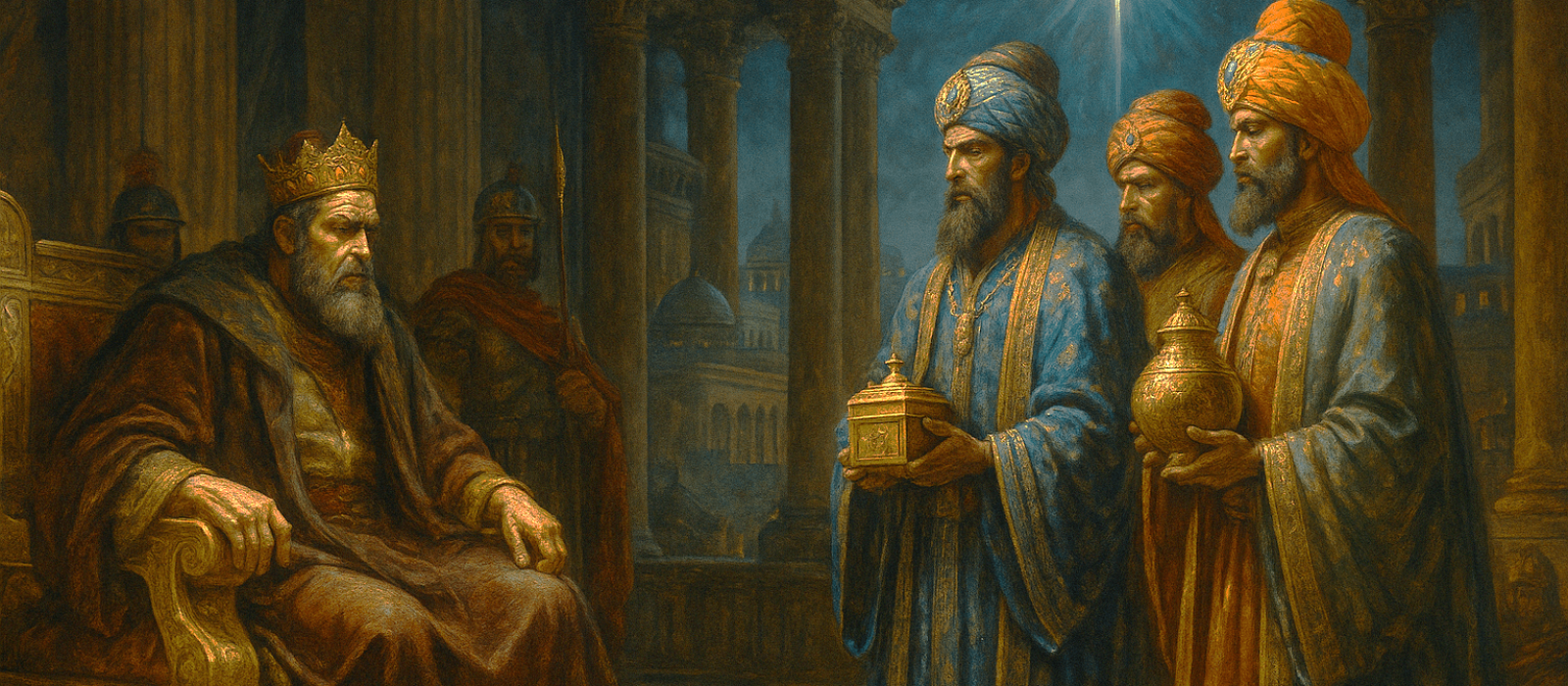
Herod’s curiosity was not easily stirred, but the persistent whispers of a child destined to be “king above all kings” eventually compelled him to summon these mysterious visitors to his court. When they finally stood before him, their appearance was as striking as their mission. Adorned in colorful robes richly embroidered with gold and precious gems, and turbans that spoke of distant lands and exotic wealth, they commanded attention.
“And what is the meaning of all this splendor?” Herod inquired, his voice deceptively cordial as he surveyed the Magi before him.
“Oh, we seek a child, O Great King,” responded one of the Magi, his voice benevolent, his eyes alight with the fervor of a devout seeker. His companions nodded in agreement, their own gazes fixed with purpose.
Herod’s interest deepened, his mind racing with the implications of their quest. “Not just any child,” another magus continued, his voice echoing the weight of a prophecy long whispered in the deserts and cities of the East. “This child, according to the stars and ancient texts, is destined to ascend above all rulers, past and future.”
King Herod the Great stroked his beard thoughtfully, the murmur of the court around him fading to a hush as all awaited his response. “A child, you say?” he mused aloud, his mind already weaving plots and plans, for no threat to his throne could be taken lightly, no matter how young or seemingly insignificant.
Thus began a chain of events cloaked in intrigue and dark designs, as Herod plotted to protect his reign against a prophecy that heralded a new era – one that could potentially end his dynasty and redefine the very nature of kingship itself. The arrival of the Magi was not just a fulfillment of celestial omens but the spark that would ignite a story of survival, legacy, and the relentless pursuit of power.
Used with permission by the author. Find the author’s complete works online: Complete Works of Mack Samuels