
Primary sources: Josephus, Antiquities Book 14; Wars Book 1.
Prophetic context (interpretive): Daniel 9:26; 11:30–31 (Kittim/Rome), Luke 21:20.
Anno Mundi 3697 (63 BCE) – THE IRON OF ROME
Their mother, Queen Salome, fostered over a decade of peace in the City of Peace, as was the last request of her dying husband, King Jannaeus. Now that she was dying, Salome asked the same of her sons, Hyrcanus II and Aristobulus II. With lips dripping with false sincerity, both of her boys readily agreed to her last wishes.
And then she was gone.
Before her passing, Salome had followed the traditions of kings and appointed their oldest son, Hyrcanus II, to the station of High Priest in preparation for his taking over as king. For years, Hyrcanus faithfully fulfilled the duties of the High Priest with a passion and an excellence that far surpassed the abilities of his father, Jannaeus. Hyrcanus would say that it came naturally to him, and he felt close to Hashem.
Aristobulus, his younger brother, was more than happy to let Hyrcanus handle that “sissy temple nonsense.” He preferred to train for war, as real kings should. And Aristobulus would often let Hyrcanus know how he felt about his weakness—and Hyrcanus would just take it, yet another example of his weakness as far as Aristobulus was concerned.
☼ ☼ ☼
It was years before, when Hyrcanus and Aristobulus were very young. Hyrcanus was two years older than Aristobulus—well, thirteen months and eighteen days. A little over a year apart would not be considered by many that far apart, nor did they look anything alike. The appearance of Hyrcanus resembled his mother more, and looking in the face of Aristobulus was like looking in the face of Jannaeus.
They were sparring, as young boys do, admiring the warring men who kept them safe. Hyrcanus was trying to show Aristobulus how to do it, but Aristobulus said he knew better and would not listen. Hyrcanus’s anger flared, and he landed a blow on his brother’s arm, causing Aristobulus to drop his weapon and start crying.
At that moment, the heart of Hyrcanus was torn to pieces, and he joined his brother in tears. When Aristobulus saw his brother crying and being empathetic, he immediately stopped crying, picked up his weapon, and walked away… laughing.
☼ ☼ ☼
Hyrcanus opened his eyes. He was no longer a boy; he was a man. And not just any man—he was king. But he was no Aristobulus. He was weak—or at least that was what people said.
A fist caught Hyrcanus’s wandering attention as he tried to turn his head away, but his hands were bound and secured tightly to the pole behind him. Hyrcanus’s face was bloodied and torn. Aristobulus stood a short distance away as one of his larger thugs did his dirty work.
“Dearest brother, I admire your tenacity in trying to be king, but at some point you have to just let go of what you can’t keep. You will abdicate, or these little sessions will continue. Plus, I would never think of taking your life. Ha! No, that would be too easy. I want you to see me as your king. I want you to wallow in self-loathing and weakness as you see a real man lead this country.”
True to his weak self, Hyrcanus abdicated.
☼ ☼ ☼
Antipater, the Idumean, was sitting down to lunch with his wife, Cypros, when he heard a sharp pounding on his door, followed by a voice: “Antipater! Antipater!” followed by more pounding. Cypros began to rise to answer the door, but Antipater’s hand motioned for her to stay.
Quickly, he stood and went to the door, opening it to reveal a bloodied and bruised Hyrcanus.
“My son! My King!” Antipater was taken aback by Hyrcanus’s appearance and by the fact that he was here all alone. Antipater spoke in a comforting tone, “What has happened?”
“I—I,” Hyrcanus stammered, as tears streamed down his face, mixing with dirt and blood, “I am no longer king.”
☼ ☼ ☼
Antipater had Cypros wash Hyrcanus as a mother would have. They sat together at the table laid out for a meal. Hyrcanus sat quietly as Antipater studied him before finally speaking, “My son, my son. Now tell me. Who has done this to you? What has happened?”
Hyrcanus looked up. “Antipater, I… it was Aristobulus.”
“Your brother? How could he? He’s family!”
“I don’t know. Maybe it’s better this way. I don’t know,” Hyrcanus confessed. Looking up at Antipater with fresh tears, he said, “You are like a father to me… I mean, especially since Jannaeus, um… and I have disappointed you.”
“No! Truly, Hyrcanus, you are to me like the son I never had!”
That last comment drew a strange look from his wife, Cypros, but Antipater just dismissed her with a glance, as if to say, “We will talk later,” then focused back on Hyrcanus.
“You are not a disappointment,” Antipater reaffirmed, “and we are going to make this right. We are going to put you back where you belong. I know people who will help us.”
Hyrcanus looked up. “What people? I don’t have the people in Judea that Aristobulus has. It seems like all of Judea is aligned with Aristobulus’s madness.”
The bitterness was evident in the voice of Hyrcanus.
“Ahh,” Antipater cooed, “they are not the people of Judea. They are our good friends in Petra, the Nabataeans!”
☼ ☼ ☼
Hyrcanus finally looked up in surprise. “The Nabataeans? But Jannaeus—I mean—he had as much trouble with them as with the Pharisees.”
“That is true,” Antipater conceded. “So very true. But unlike the Pharisees, the Nabataeans are reasonable, I would say. As much conflict as Jannaeus had with them, they took it as good sport. Truly, they were saddened when he passed. Have they caused Judea any strife, to your knowledge? No! Of course not! Like everyone else, they need to be respected. And like everyone else, you need to be respected. You and the Nabataeans have a lot in common—being misunderstood, being seen as weak, when in reality you both can be as vicious as lions!”
Antipater clawed the air and made a quick growl, akin to that great beast’s. “But I leave it up to you. If you think Aristobulus knows best, well, I don’t want to interfere. But if your place is as High Priest and king of Judea, we will deal justly with Aristobulus and regain your rightful place.”
Hyrcanus thought about it. “I am so angry, and I have been humiliated in front of all of Judea.”
“Go on,” Antipater urged.
“And what is needed to humble that arrogant Aristobulus is a show of force and resolve. Maybe I am weak in some ways, but not in every way,” Hyrcanus said, looking up at Antipater to make sure he was saying the right things.
“Go on,” Antipater encouraged. “Yes, yes, go on! You are not weak!”
“No, I am not.” Hyrcanus sat up straight, nobly, and looked to Antipater with a newfound courage, even if slightly borrowed, and commanded, “Send word to the Nabataeans! We will have justice!”
“Oh, I will do you one better than that. Come with me. We will go to the court of King Aretas and plead your case directly! He can see the man you are. Besides, do you think your brother will really just let you walk away? You are a liability. If word gets out about what we are planning, that will be the end of your life—and likely mine as well. We have to go now, get out of Judea, and consider our next steps carefully.”
☼ ☼ ☼
Hyrcanus and Antipater slipped out of the city and acquired a couple of camels from Ishmaelite traders. They had traveled deep into the scorching desert. Their only companions, other than each other, the camels, and the great light beating down on them like a hot iron rod, were the many rocks and stones scattered along the landscape.
Having traveled for three days, Hyrcanus worked hard to stifle complaints of discomfort. The sand—always the sand—and the heat. He was on a mission. Besides, Antipater kept his mind occupied by giving him important historical, geographical, and military knowledge, so that he would be prepared to meet the king of Petra.
And, subtly, the land around them began to change. More people could be seen coming and going. It was a small town, maybe a village?
“Ah,” Antipater said, “the town, Siq. We can rest a bit, water our camels. Then it’s just maybe another half hour to Petra. You really have never been here?”
“No,” Hyrcanus admitted, “don’t like to travel. Don’t like the sand.”
“I see, I see!” Antipater said with a laugh. “No doubt it is not for everyone.”
As they entered the city, they found the watering place. In under an hour, they were rested, their camels watered, and they were through the city. Their flat desert plains with rocky accoutrements had been replaced by a very narrow pass, steep sandstone cliffs, and high red walls. This was the entrance to Petra, and it would not take terribly long to traverse. This was one of the many features that made Petra highly defensible, as soldiers on the high bluffs could easily subdue any advancing force from afar.
As they began their own conquest of the pass, the most obvious variations from the outside sandy desert were the green sprouting places along the path, where the high walls sheltered the narrow valley from the intense sun most of the day. But as they got closer to Petra, green was everywhere. Lush gardens could be found, some with flowers, others with vegetables and herbs.
As Hyrcanus peered more deeply into the details of everything, nearly all areas seemed to drain into aqueducts or through channels to what looked like cisterns. Though everything was carved in the soft sandstone, the engravings were ornate and highly detailed, often coated in gold or silver edging—sometimes even brass.
Just then, Antipater held up a hand, and both their camels came to a stop. Antipater spoke with some men who stepped in front of them. It sounded like they were speaking Arabic, but that wasn’t a language Hyrcanus was familiar with.
The men waved them through.
☼ ☼ ☼
Antipater took Hyrcanus to the front of a magnificent entrance. He could see aspects of Roman and Greek architecture, even some Egyptian. So, at least three centuries to carve out the various rooms and halls?
But what Hyrcanus was not expecting was the grand hall the king used as his throne room. It was lavish. The ceilings were astoundingly high and very smooth, with beautiful stone variations within the sandstone. Even the veins of likely much harder foreign stone captured in the sandstone were seamlessly smooth.
The vastness of it all.
Every step, every shuffle of their feet, echoed endlessly. And then the king stood and bowed slightly. Antipater, and then Hyrcanus, did likewise. The king waved them forward in almost a casual gesture.
“Antipater! So nice!” His Majesty said glibly in Aramaic, most likely for the benefit of Hyrcanus. “It’s been too long. And who is your friend?”
Without hesitation, Antipater turned and gestured. “This is King Hyrcanus II; he’s like the son I never had.”
This, too, provoked a look from the king, but with regal majesty, the king offered, “Well, King Hyrcanus II, I am King Aretas III. You are most welcome here. You are, then, a Judean? Two camels do not seem fitting for the King of Israel.”
“No,” Hyrcanus said sternly. “It certainly isn’t. But my brother, Aristobulus, turned the heart of the people away from me, deposed me, and sent me into exile.”
“And what is it that you would have me do for you, dearest King Hyrcanus?” Aretas responded, trying not to appear too eager.
“You must help me turn their hearts back—by force, if necessary—and it is Aristobulus who will go into exile.”
Hyrcanus stood looking not at Aretas but at the ground, with his arms tightly crossed against his chest.
“I see. Well, as you already know, help is never without a cost. What do you have that a king like me would want as payment?” Aretas pondered aloud.
“Well,” Hyrcanus said, looking at Antipater, who nodded, “you are a king of great reach. Your power is your control of trade and this region. Therefore, what if I gave you your choice of any four cities in the regions of Moab or Gilead?”
“Four?” Aretas said in a playfully insulted tone. “From the regions of Moab or Gilead, you say?” Aretas stroked his beard slowly as he mulled over the offer. “Four?” he repeated, looking up at the ceiling. “I mean, I suppose it sounds reasonable. But sounding reasonable and being reasonable are, well, hmm…”
Aretas let the echoes of his last sentiments fade and then suggested, “How about twenty? Yes! Twenty would be more than enough compensation for helping you win back what is clearly rightfully yours. Certainly, twenty cities? It is a good region, close by. Why not twenty?”
Hyrcanus looked again to Antipater, who shook his head ever so slightly. Then Hyrcanus said, sounding as forceful as he could muster, “Twenty? That does seem like more than enough compensation, but more than enough would, by definition, be too much. Just as you should not be expected to give charity for your services, I should not give charity in my compensation. You are not a king who needs charity, I dare say. But still, I can be generous—let’s say I double my offer to eight cities.”
The heart of Hyrcanus was galloping wildly. This was not the sort of thing he had ever done before. He tried to put on a stoic bluster, but he was horrified and nervous, even while Aretas was apparently greatly enjoying himself.
“Well,” Aretas once again demurred, “generous you certainly are! Thoughtful, kind! I bet your poetry is like a first love. Your offer is tempting—most tempting, in fact. But, as I do the numbers in my head, it is a difficult justification. I know, let’s split the difference and say fourteen cities. That seems fair—not too charitable?”
“I see,” Hyrcanus said. This time, Antipater nodded ever so slightly. Hyrcanus thought about it. “Well, fourteen. You would no doubt have to choose between big and little here and there, but what if I offered you the twelve most ideal cities, and I will tell you why each is of strategic importance to you?”
“Well, well, well,” Aretas responded gleefully, “that could take all night!”
With a snap of his fingers, tables and chairs were brought in, along with linen and candles, and platters of the most exquisite foods, along with much wine.
“Why don’t we get right down to it?”
Their negotiations would go well into the night, and their conversation would meander away many times into who Hyrcanus was, Aretas’s many wives, the mutual friendship with Antipater, the history of Judea and Jannaeus, and much more.
The next morning, they all woke up late. A breakfast was already ready and waiting.
“Ah, my good friends,” King Aretas greeted them as they entered the hall, “we have much to discuss. Namely, we need to figure out a strategy to take back the hearts of your Judeans, with as little damage to your City of Peace as possible. Here is what I would suggest…”
☼ ☼ ☼
A distant shofar startled Aristobulus from his slumbers.
Immediately, an advisor came in and bowed. “O great king.”
“What is it?” Aristobulus demanded.
“An army is advancing from Petra. It’s the Nabataeans.”
“What is this?” Aristobulus said to himself, as he got out of bed and looked out a window. There was nothing to see. Turning to the advisor, “Distance?”
“About a day away,” he said, his eyes still lowered.
“Assemble the generals.”
☼ ☼ ☼
Hyrcanus arrived with Antipater and the army of the Nabataeans. As expected, Jerusalem was shuttered tightly—fortified, and impregnable. According to the strategy laid out by King Aretas, they circled the City of Peace in preparation for war.
The siege lasted two years. In addition to the scarcity that eventually arose inside the city, zealous loyalists to Aristobulus tried to fend off attacks from those aligned with Hyrcanus, who were just as zealous and just as loyal. Neither could gain a decisive advantage. In desperation, both Aristobulus and Hyrcanus secretly sent envoys to appeal to Rome. A general was sent—his name was Pompey.
☼ ☼ ☼
Hyrcanus and Antipater were deciding how to spend the day and what new strategies might be available to them when their attention was captured by a distant Nabataean bugle. They looked at each other, then behind them, before standing in hope and wonder.
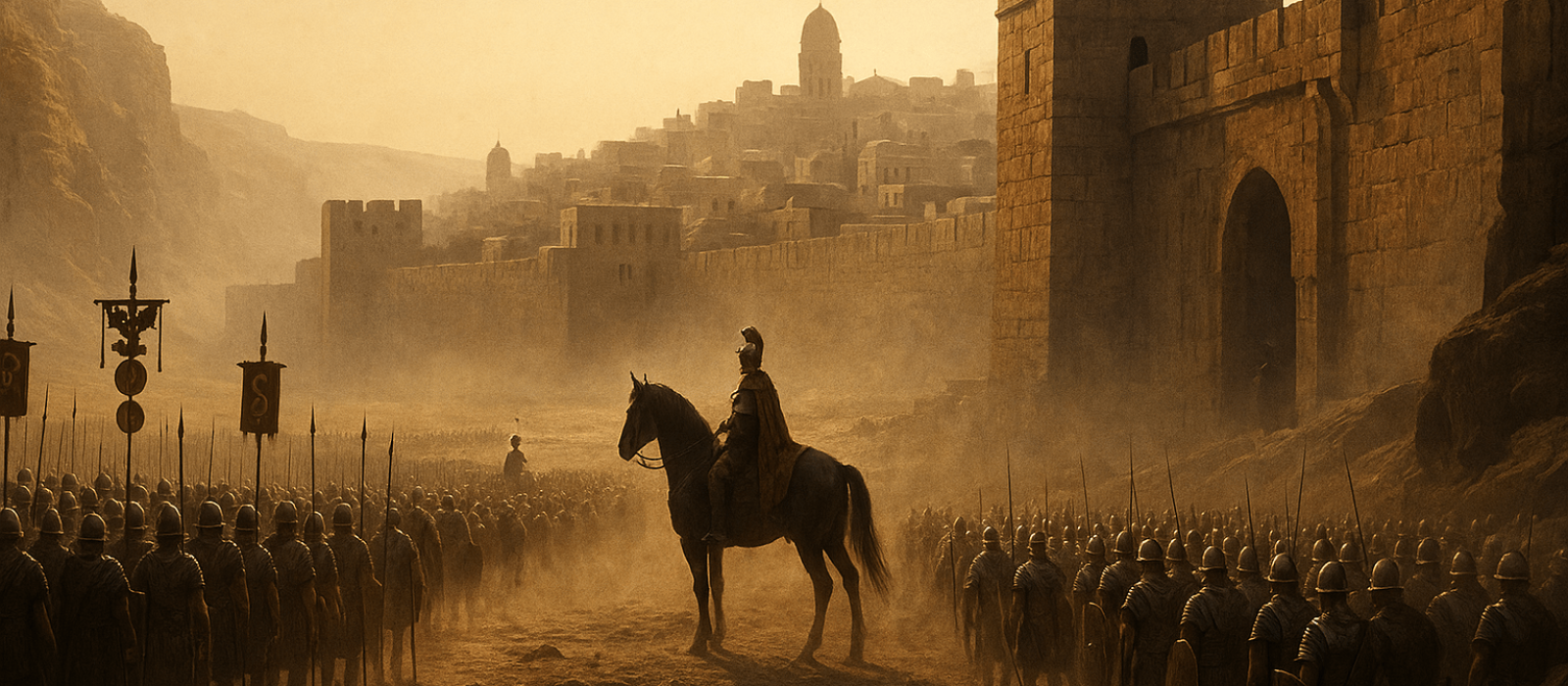
The ranks of the Nabataeans parted like a sea of humanity—perhaps even like the Sea of Suf once had for the Jews. But this time, it was some five hundred Romans on horse and on foot, with a massive cloud of dust billowing behind them.
Compared to the Romans in discipline and dress, the Nabataeans looked primitive and, dare I say, weak. Another Nabataean horn sounded, and it was clear the Nabataeans were breaking camp. Hyrcanus just stood and watched as a general rode straight up to him and looked him in the eye.
“Which one are you?” the general demanded. “Hyrcanus or Aristobulus?”
Hyrcanus looked to Antipater, who gave him a shrug. Hyrcanus looked back at the general, who had a manner of patience, but from his hot, dusty appearance, Hyrcanus knew it would not last long.
“I… I am. Hyrcanus, I mean. That’s me.”
The general motioned, and the Romans took up position as they soon displaced the Nabataean army. Before long, the Nabataeans were but a dusty trail of indistinct humans.
The general, however, could care little about the Nabataeans. He motioned to one of his veterans, who cautiously approached the gate. With a huge hammer, he pounded several times before retreating back to his animal.
Minutes passed.
Soon, Aristobulus appeared at the top of the gates.
“You must be Aristobulus?” the general intoned as he looked up. His voice carried easily to the top of the gates. It was forceful and definitive. “You have appealed for the assistance of Rome, and I am here to listen to your request.” Looking to Hyrcanus, the general added, “To both of your requests.”
Aristobulus stood for a moment, pondering, considering. Then he snapped his fingers, and a single access door was opened. The general looked at Hyrcanus and Antipater. “You two, with me,” he ordered as he headed for the gate. Looking back to his Praetorian guard, he added, “You as well.”
☼ ☼ ☼
Aristobulus hosted all four people in a large hall, with a long table set aside for dignitaries. The general had Hyrcanus sit opposite Aristobulus, while he and his guard sat in the middle.
“Now,” the general said, “I am General Pompey. You have both appealed to Rome for assistance. We are not sure why, so I was sent to hear your appeals—each of you, in turn. Who would like to start?”
Silence enveloped the room as the two brothers stared at each other, Aristobulus in animus and Hyrcanus in fear.
“I was king first,” Hyrcanus blurted, sounding not much older than a young adolescent. “That is, our mother, Salome, made me High Priest and king when she went to sleep with our ancestors. Aristobulus, in one breath, told her he would keep the peace, while, in another, he deposed me and sent me away as soon as he could poison enough Judeans to do so.”
“With the help of my friend Antipater, we raised an army from the Nabataeans, and we have laid siege, hoping Aristobulus would see the light and give up. But…”
Hyrcanus trailed off. He could have said more—maybe—but he let his words lie as they were.
“I see,” the general said finally. “And what say you?” he asked Aristobulus, giving him his full attention.
Aristobulus was slower to answer. It was true that he had asked for the general’s assistance, but his arrival alone had solved his issues. All he really needed was for the general to leave. He could take care of the rest… and his brother.
“Hyrcanus is weak. He is an embarrassment to me, and he is an embarrassment to the memory of my father, the king, Jannaeus. He does not deserve to be king. He should not even be allowed to own a dog. He is a disgrace, and he is dead to me as a brother.”
The general waited a few moments to make sure Aristobulus had finished. “My, my,” the general said, “this is quite the conundrum. What should be done?” The general drummed his fingers as he took turns looking at both men. “So—two boys, fighting over a city they didn’t build, demanding loyalty of people they do not care about, seeking power they know not what to do with, all so they can laud it over the other.”
Again, the general was silent, looking at each. Hyrcanus looked down in shame, while Aristobulus’s face was set in a stunned anger that made his head resemble a strawberry.
With a sigh, the general broke the silence. “I’ll tell you what is going to happen. Neither of you will be king… for many reasons. You both will abdicate any claim to the throne of Israel. You will submit to the authority of Rome, allow a legion to police Judea, and pay regular tribute. If you do that, you will be allowed to stay here with your people, to enjoy the peace that will be maintained by Rome.”
The general had barely finished when Aristobulus spoke out in protest, “There is no way! Who do you think you are? We are not in Rome. We do not answer to you.”
“I see,” was his only response. No reaction could be noticed on the general’s face. He simply turned to Hyrcanus, who was still looking downward. “Is that how you feel as well, O great King Hyrcanus?”
Hyrcanus looked up and caught the eye of the general, then quickly looked away, saying, “I, uh… whatever.”
Once again, the general responded, “I see.” Standing up, the general straightened his clothing, as if getting ready to depart.
“That’s it?” Aristobulus asked, surprised. “You are leaving?”
“No, unfortunately, I can’t,” the general said to Aristobulus. “You see, this whole situation—which I am convinced is your doing—cannot be allowed to continue. I am no stranger to internal strife. How many have died because of you two? Let me tell you how many thousands will die if you force my hand. I am not just a general of Rome—I am Rome. In four days, I will have an army ten times the size of what I brought with me. You could not survive what I brought with me; you certainly will not survive that tenfold. So, once again, I respectfully request that you stand aside, abdicate your claim to the throne, open the gates of Jerusalem, allow my men to take control of the city, pay the tribute due, and live in peace here with your people.”
“Request? You request!?” Aristobulus could not process the hubris of this man. He was Rome? What arrogance! “I cannot! I will not! You have no right! You have no right!”
“Very well,” the general said. “If I walk out this door, you had better shut it tight—because I will be back, and I will be knocking with something more substantial than a hammer.”
“Get out!” Aristobulus shouted. “Get! Out!”
☼ ☼ ☼
The gates of Jerusalem shut with a thud. The general looked at Hyrcanus, “And what shall we do with you?” he implored.
He answered meagerly, “I, uh, all I ever liked doing was being high priest. I was good at that.”
To the general, Hyrcanus seemed broken, lost. “I will tell you what. You will once again be high priest, as well as ethnarch.”
“Ethnarch?” Hyrcanus inquired.
“It’s a title like king. But your authority comes from Rome, and you must have our authorization. Basically, you can handle the little stuff of ruling, and we will take care of the bigger matters of state. Focus on being high priest and make your people happy. As far as your brother, he and his family won’t be killed. He will be humbled, which may take some time. So, we will bring them all to Rome until we get it sorted out. But we will keep him and his family out of your hair. You just make sure that tribute is paid on time.”
“Uh… how much tribute?” Hyrcanus asked nervously.
“Don’t worry,” the general said warmly, “it won’t be much. Just a small percentage.”
☼ ☼ ☼
Of the many things you could say about the Roman General Pompey, you could not call him a liar. Everything he said came to pass in the time and manner he dictated. The loss of Jewish life was tremendous, especially as Aristobulus refused to surrender. The vicious iron of Rome knew no sympathy. Eventually, however, Aristobulus was captured and imprisoned in Rome along with his family, and Hyrcanus was restored as high priest and ethnarch… whatever the heck that is.
Used with permission by the author. Find the author’s complete works online: Complete Works of Mack Samuels