
Parashah Vayera Comments (Revised)
The Torah is the foundational text of the Bible, of Judaism, and of Christianity. Comprised of Genesis, Exodus, Leviticus, Numbers, and Deuteronomy, it teaches us: (1) obedience brings life and blessing; (2) rebellion brings adversity and death; and (3) God’s revelation culminates in His Anointed One—the Messiah.
The Torah often signals Messianic lessons through patterns: life emerging from death or barrenness, descents and ascents, and recurring triads (“three”). In this week’s parashah, Vayera (“He appeared”), two such patterns stand out: the announcement and birth of Yitzchak (Isaac) to Avraham and Sarah—life from barrenness—and the Akeidah, the binding of Isaac, which prefigures death and resurrection.
Isaac’s Birth: Life From Barrenness
Isaac’s birth to a woman long past child-bearing age foreshadows the miraculous birth theme fulfilled in Messiah. The narrative places Avraham at 99 and Sarah at 90—numbers resonant with Torah’s triadic motifs.
The Akeidah: Death and Resurrection Foreshadowed
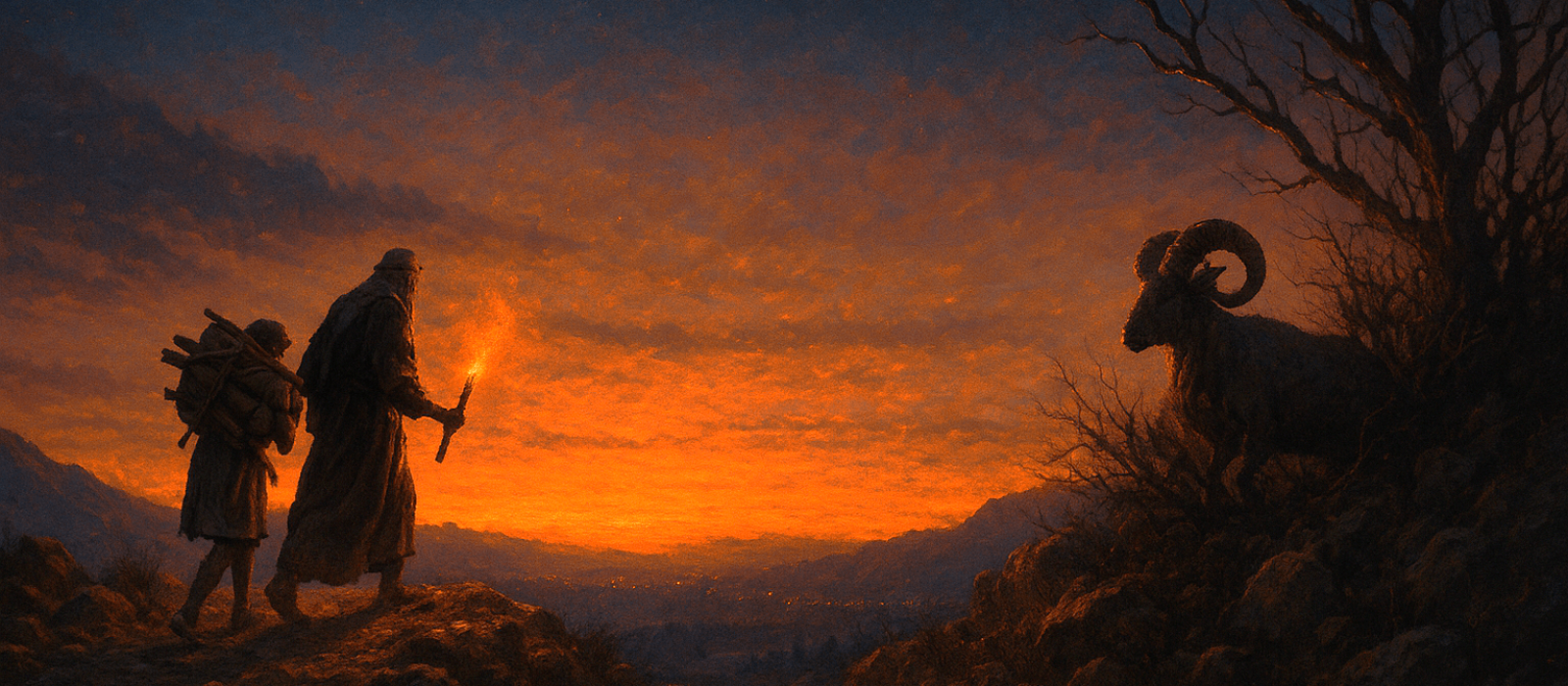
In the Akeidah, Avraham raises the knife over his “beloved son,” and God halts the sacrifice. Isaac is, in effect, given back from certain death—life from death—after a three-day journey to Mount Moriah.
“Abraham took the wood for the burnt offering and placed it on his son Isaac.”
In parallel, Yeshua carries the wood of His execution stake.
“Carrying his own cross, he went out to the place of the Skull…”
Torah calls Isaac Avraham’s “only son,” highlighting the unique, covenantal heir.
“Take your son, your only son, whom you love—Isaac—and go to the region of Moriah…”
The New Covenant writings echo the “one and only” language concerning the Son.
“We have seen his glory, the glory of the one and only Son, who came from the Father, full of grace and truth.”
Moriah, the Temple, and Golgotha
Mount Moriah, site of Isaac’s near-sacrifice, later becomes the Temple mount where God’s Presence dwells among Israel (see 2 Chronicles 3:1). Believers also note the typological link: the heights of Moriah overlook the area associated with Yeshua’s crucifixion, intensifying the Akeidah’s foreshadowing.
Two Messiahs, One Messiah: Rabbinic Frames and Messianic Faith
Rabbinic texts speak of Messiah ben Yosef and Messiah ben David. Messianic readers see these fulfilled in one Messiah with two advents: a first arrival in humility and suffering (miraculous birth, like Isaac), and a second in victorious resurrection and kingship.
“Parable” in Hebrews and the Ancient Midrash
Hebrews frames the Akeidah as a figurative receiving back from the dead.
“By faith Abraham, when he was tested, offered up Isaac… concluding that God was able to raise him up, even from the dead, from which he also received him in a parabole (parable/figure).”
Ancient Jewish tradition enriches this reading. Pirkei de-Rabbi Eliezer 31 tells that when the sword touched Isaac’s throat, his soul departed and returned at God’s command—an image of resurrection. Paul’s “parable” thus aligns with known midrashic patterns familiar to a Jewish audience.
Isaac’s Willingness and Merit
Isaac is not a small child; Avraham is well past 100. Isaac could have resisted but submits to his father’s will, prefiguring the obedient Son. Rabbinic commentary further teaches that, in Isaac’s merit, the faithful will share in future resurrection.
Haftarah Echo: The Shunammite’s Son
The Haftarah mirrors the parashah through Elisha’s raising of the Shunammite’s child, reinforcing the pattern of life from death.
“…then the child sneezed seven times, and the child opened his eyes.”
Ram’s Horns, Sinai, and the Great Trumpet
Midrash links the ram’s horns to shofar blasts at Sinai and to the “great shofar” of the ultimate redemption (cf. Isaiah 27:13). When objections arise (burnt offerings are fully consumed), discussion turns to God’s power and the resurrection motif—classic pilpul that refines understanding rather than dismissing tension.
Akeidah: “Ringed/Striped” and the Servant’s Stripes
The Hebrew root akad in Genesis 22:9 literally points to being “ringed/striped,” evocative of the rope marks left by binding. This image resonates with the Suffering Servant’s “stripes.”
“He was wounded for our transgressions… and by His stripes we are healed.”
Covenant Reciprocity and the Demand of Love
Parents long to bear their children’s pain. Avraham’s willingness to surrender Isaac does more than foreshadow Yeshua’s sacrifice; it presses covenant reciprocity—if Avraham withholds not his son, God’s covenant faithfulness will be revealed in kind. The Akeidah becomes a demand as well as a sign: God Himself will provide the Lamb.
“The Place” (Ha-Ma’on) and Eyes That See
Vayera also explores sight. Avraham “lifts his eyes” and sees “the place” (ha-ma’kom) from afar—a term rabbinically associated with God’s dwelling. Traditions recount Avraham discerning what others could not. Spiritual sight is a gift God gives in His time.
“Adonai has not given you a heart to understand, eyes to see or ears to hear…”
“…God has given them a spirit of dullness—eyes that do not see and ears that do not hear…”
“Blessed are the eyes that see what you are seeing!”
Pilpul Toward Unity
Careful argument—pilpul—is not hair-splitting for its own sake but a covenant practice of seeking clarity together. When Jews and Gentiles reason together in humility, we approach the unity promised to God’s family.
Avraham’s Third Day and the City With Foundations
Avraham tells his servants, “The boy and I will go… worship and return” (Gen. 22:5)—a statement of trust after a three-day journey. Hebrews reads Avraham’s gaze as longing for the city with foundations, whose architect and builder is God—the consummation of covenant hope.
“On the third day, Avraham raised his eyes and saw the place in the distance… ‘We will go… and return to you.’”
“For he was looking forward to the city with permanent foundations, whose architect and builder is God.”
Conclusion and Prayer
Some do not yet see; some see dimly; none has yet seen face-to-face. But the Master will be revealed in God’s time. Those who truly seek will be given ears to hear and eyes to see. May we walk together toward that day.
“Your teacher will no longer hide himself; with your own eyes you will see your teacher.”
“They will see his face, and his name will be on their foreheads.”
Amen: Avinu, if it be Your will, send Your Son soon. May it be so, and in our days.