
Parashah Acharei Mot Comments (2014)
(Most of this material is from Middletown Bible Church, Middletown, CT; source.)
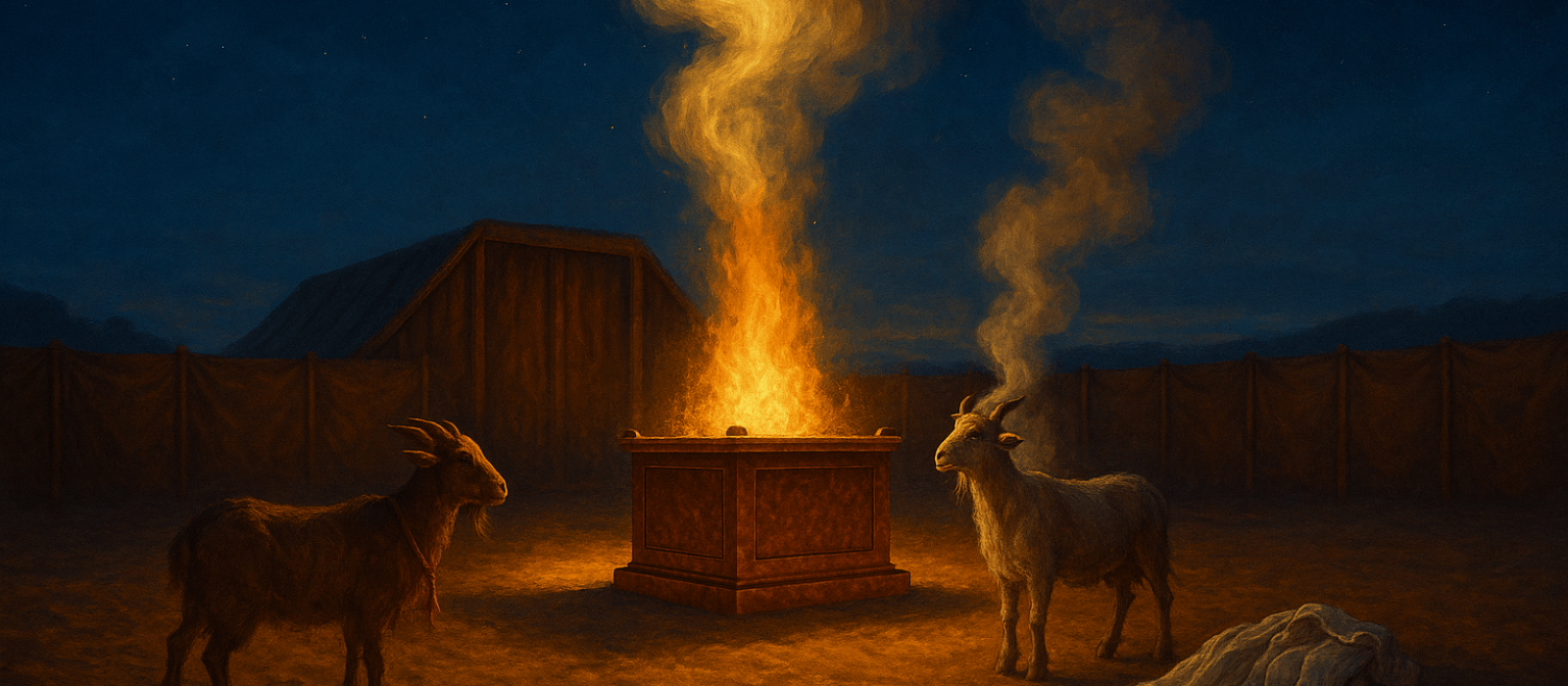
In this week’s Torah reading, we read of the High Priest’s requirements in the sacrifice made to atone for the sins of the people. It is done every year. It is a picture of the transferring of the people’s sins to an animal whose death is the symbolic result of the sins of the Nation of Israel. The death of the animal, expressed by its shed blood, is the punishment that should have been the Nation’s due, but was borne by the substituted animal instead. It is a ceremony that cannot take place in its original form today because there is no Temple, no place of sacrifice. Yet the Day of Atonement is observed by Torah-observant Jewish people with fasting, prayer, and refraining from all work. It is the most solemn Holy Day in the year.
What it says to me is that, as a traditional Jewish person who believes in God, you can only hope to draw nearer to Him at this time, but the animal sacrifice is only temporary—you do this every year if you are pious.
The Day of Atonement points to the sacrifice of Yeshua, a better sacrifice, because, as our High Priest, He entered the true Holy of Holies—God’s presence—through His death, and not the man-made Temple in Jerusalem. Because of His perfect, unblemished (sinless) life offered for us, He took the punishment meant for all of us and for all time. The entire Torah points to the Messiah, and the Messiah is Messiah Yeshua.
The Newer Testament makes it very clear that Yeshua is the Messiah. But it is not necessary for Jewish people to accept the Newer Testament to know about Yeshua HaMashiach. If a sincere Jewish seeker of God will open heart and mind, he or she can come to know the Messiah from the Holy Scriptures of Moses, the Prophets, and the Writings. That is how I came to faith—as a Jew who thought he was “good” and didn’t need to be saved. This is Jewish evangelism 101.
Israel’s Calling and God’s Faithfulness
In the Hebrew Scriptures the Jews are said to be God’s special and chosen people.
Israel as a nation has suffered greatly and the Jews have been persecuted more than any other people, yet the future for this nation is bright. God has a great plan for His chosen people. All the prophets predicted a great kingdom age—a time of peace, prosperity, and worldwide blessing. These promises will be literally fulfilled.
It is the Jews who, down through the centuries, have preserved the Bible and copied the Scriptures carefully and meticulously so that today we can have these sacred writings. The Hebrew Scriptures (the Tanakh) and, I would add, all the books of the New Testament were penned by Jews.
Many of the great men of God whose words and deeds fill the Scriptures were Jews: Abraham, Isaac, Jacob, Joseph, Moses, Joshua, Samuel, Jonathan, David, Elijah, Elisha, Isaiah, Daniel, Ezra, Nehemiah, and others. Most importantly, Yeshua Himself was a Jew—son of Abraham, of the tribe of Judah, of the royal line of David.
Purpose: to present to Jewish people a simple, clear message from the Bible. Every quotation in this teaching (outside of attribution) comes from the Hebrew Scriptures.
Message to Israel
God called out a nation unto Himself—Israel—to witness to the One True God in the midst of universal idolatry and to be the depository of His Word.
God’s Word is truth and endures forever.
What Is Man’s Basic Problem?
All of us have strayed; none is righteous by God’s standard.
What About God?
God is holy and opposes evil, yet He desires the wicked to turn and live. Salvation must come from Him.
He commands us to be holy as He is holy—an impossible standard without His provision.
Why Was Abraham Righteous?
Abraham was not sinless, yet God counted him righteous because he trusted the LORD.
Faith is man’s part; God’s part is to provide salvation.
God’s Plan of Salvation in Torah
From the beginning, God shows that covering (atonement) requires shed blood and an innocent substitute.
The Ten Commandments expose our guilt; the sacrificial system reveals God’s remedy—a spotless substitute “without blemish.”
God’s Promise of a Savior (Messiah)
Messiah will come through Abraham, Isaac, Jacob, Judah, and David; He will be born in Bethlehem of Judah and be called “Mighty God.”
Does Messiah Have to Die?
Yes. From the first promise onward, Scripture anticipates a suffering, “bruised” Redeemer, and Daniel foretells that Messiah will be “cut off.”
The Time and Manner of Messiah’s Death
Daniel’s seventy “weeks” point to the timeframe; Psalm 22 and Zechariah 12:10 describe crucifixion-like piercing, centuries before Rome employed it.
Why Must Messiah Die?—Isaiah 53
Isaiah 53 presents an individual, righteous Servant who suffers as a substitute for “the many,” bearing our iniquities and bringing healing and justification.
He was rejected and slain, smitten by God for our sins, silent like a lamb to the slaughter, yet promised to see offspring and prolong days—implying resurrection.
What Must I Do?
Believe the report. Trust the God of Israel who promised and provided the Messiah. The cost can be real, but the blessing is greater: refuge in Him.
May the Ruach HaKodesh use your understanding of Yom Kippur—the Day of Atonement—as a window leading to the truth that the Messiah is Yeshua.