
Parashah Bamidbar Comments
The Hebrew name for the fourth of the Five Books of Moses is Bamidbar (“In the Wilderness”) and describes the Israelites’ forty years of wandering in the Sinai desert. The name most familiar to Christians is “Numbers.” The first Torah portion of the book is also called Bamidbar. This reflection considers two facets of the portion that illuminate God’s primary commandments: to love Him and to love one another.
36 “Teacher, which is the greatest commandment in the Law?”
37 Jesus replied: “ ‘Love the Lord your God with all your heart and with all your soul and with all your mind.’ 38 This is the first and greatest commandment. 39 And the second is like it: ‘Love your neighbor as yourself.’ ”
For many of us, the opening chapter’s counting of Israel once felt tedious. How could a registration list connect to the heart of our faith? On a closer reading, the census is love in action, and the portion as a whole harmonizes with Yeshua’s words above.
“You Count”: The Census as Covenant Love
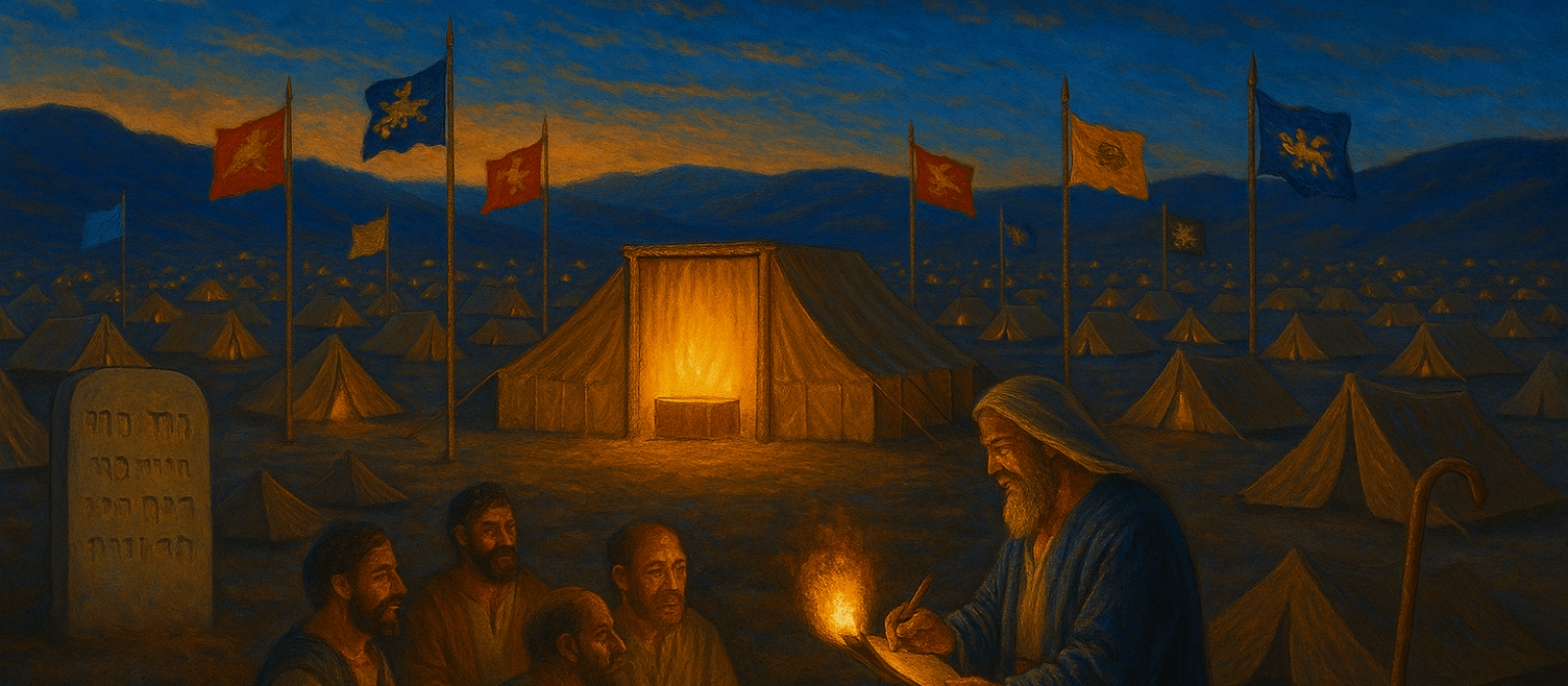
“Take a census of the entire assembly of the people of Isra’el, by clans and families. Record the names of all the men twenty years old and over who are subject to military service in Isra’el. You and Aharon are to enumerate them company by company.”
Like the Good Shepherd who leaves the ninety-nine to seek the one, God’s counting declares that every person matters. Whether a prominent leader or a quiet soul in the camp, each one is seen, known, and counted—no more and no less than a brother or sister. Parents of large families know the impulse: before moving on, you count because you love. God’s love expects and commands our love in return.
Family Lines and Shared Identity
The registration is by families and clans. Each household could trace its ancestry back to one of Jacob’s (Israel’s) twelve sons. Israel is, in this sense, one vast family. Within each tribe were extended families (clans), and within those clans were the beit av (father’s house). The Hebrew word mishpochah (or mishpachah)—“family”—echoes throughout Numbers.
While biblical patriarchy can feel confining to modern readers, in its ancient context a woman’s father and husband represented social standing, protection, and provision. Scripture also shows women who step beyond typical patterns, but these are exceptions that prove the rule. Paul’s language of “adoption to sonship” (Romans 8:15, 8:23; 9:4; Galatians 4:5; Ephesians 1:5) reflects this family structure as the way Gentiles are joined to Israel’s household.
Redemption Around the Table
“Then Moses summoned all the elders of Israel and said to them, ‘Go at once and select the animals for your families and slaughter the Passover lamb.’ ”
Passover is commanded family by family; the Exodus is re-told annually at the Seder table. Purim likewise turns on family faithfulness: Mordecai (uncle/guardian) and Esther (adopted niece) combine courage and kinship to expose Haman’s plot (see Esther 9). Hanukkah remembers the Maccabees—Judah and his family—who resisted the Seleucid oppression under Antiochus IV; a later echo appears in John 10:22 (“It was winter, the Feast of Dedication in Jerusalem”).
Strength in Covenant Solidarity
“The Spirit of God fell on Sha’ul when he heard this; blazing with anger, he seized a pair of oxen and cut them in pieces; he sent them throughout Israel saying, ‘Anyone who doesn’t come after Sha’ul and Sh’mu’el—this will be done to his oxen!’ The fear of Adonai fell on the people, and they came out with united hearts.”
In crisis, Israel rallies as family—tribes rising with “united hearts.” The Talmud captures the same ethic: “One of a city benefits the entire city; two of a family benefit the entire family” (Sanhedrin 111a). Even the wordplay between shifchah (handmaiden) and mishpochah hints that those who serve among us are to be treated with familial dignity. When those lines blur—as with Hagar and Sarah—relationships strain, a cautionary tale within the family story.
From Torah to Today
Family loyalty is not theoretical. Many of us can tell stories of caregiving, grief, and sacrificial love that reveal how God’s design steadies us. In some households, money becomes a wedge; in others, it becomes a tool to bless. The difference often traces back to the covenant choice to love God and love one another first—and to let everything else serve those two commands.
“Why the Jews?”
A parable tells of a king who loved one garment most because it clung to him. God created all peoples, yet Israel “clings” to Him in a unique covenant (Deut. 10:20). Blaise Pascal, asked for proof of God, answered, “Why, the Jews, your majesty—the Jews.” Israel is called “chosen” not as a prize of privilege, but as a vocation: to reveal God to the nations and to bear the weight of His promises.
Tikkun Olam: Repairing the World as Family
Jewish ethics speaks of Tikkun Olam—repairing the world. Bamidbar’s census reminds us that repair begins with rightly counting: seeing each person as family. Saving one is like saving all; injuring one injures the whole. Whether circumcised in flesh or in heart, whether born Jewish, a convert, or grafted-in as Paul describes, we are called to be family to one another.
Nothing rises higher than these two commandments. Everything else—teachings, judgments, exhortations—flows from them. Bamidbar’s lists are not lifeless; they are love in ledger form.
Father in Heaven, thank You for giving us strength and identity through Your love, and for commanding us to love You and one another in our households and as Your greater family. Amen.