
What Is the Significance of Chanukah to Jews—and What Does It Mean for Messianic Believers?
Jewish holidays are often remembered for deliverance followed by celebration, and Chanukah fits that pattern. It recalls the uprising led by the priest Matityahu (Mattathias) and his sons—especially Yehudah (Judah), called “Maccabee,” “the hammer”)—against the decrees of Antiochus IV. After pagan defilement of the Temple altar, the Maccabees overcame a stronger empire, restored worship, and rededicated the Temple.
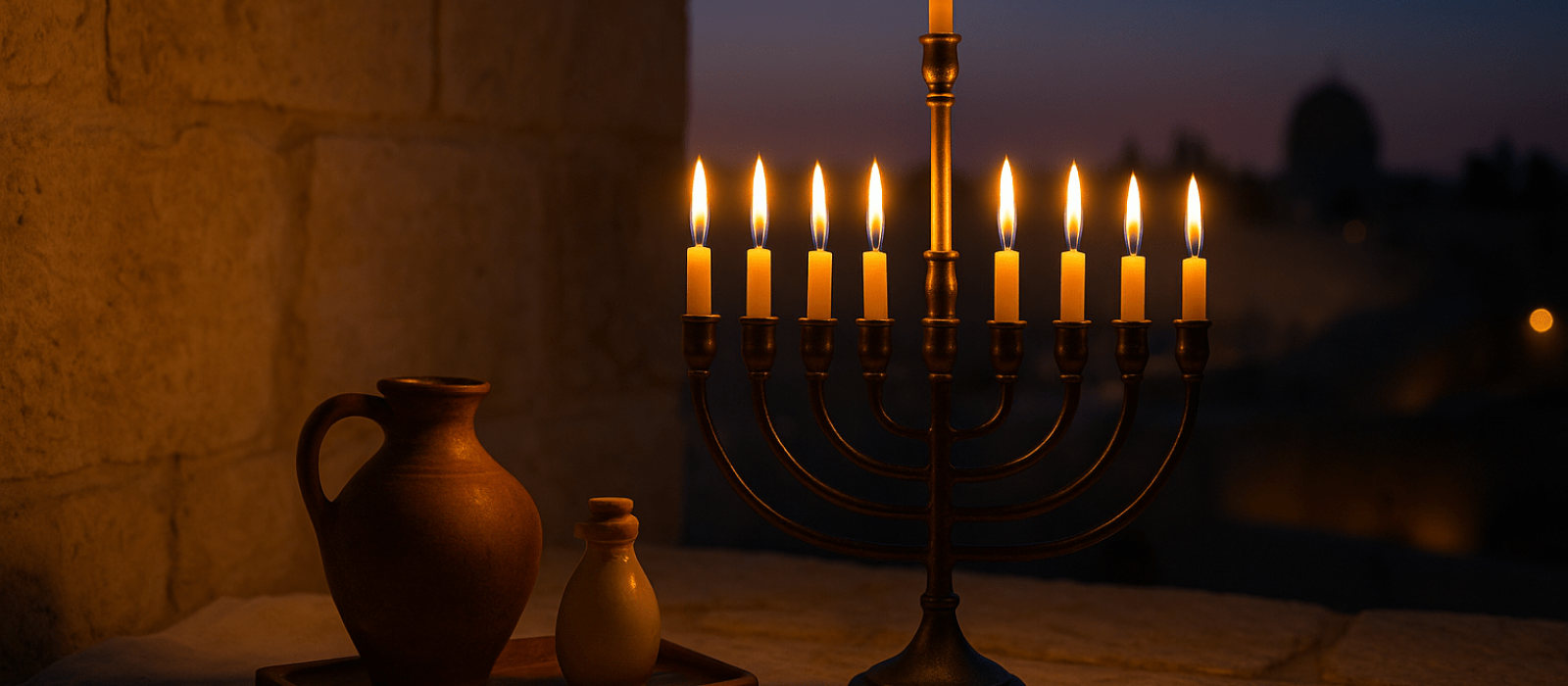
The Miracle of the Oil and the Chanukiyah
The Talmudic tradition tells that only one day’s supply of pure oil could be found to relight the Menorah, yet it burned eight days—long enough to produce more oil. In remembrance, we light a chanukiyah (an eight-branch lamp plus the shamash helper candle) for eight nights.
Blessing for Lighting Chanukah Lights
Blessed are You, Adonai our God, King of the universe, who has sanctified us by Your commandments and commanded us to kindle the light of Chanukah.
Blessing for the Miracles
Blessed are You, Adonai our God, King of the universe, who performed miracles for our ancestors in those days at this season.
For the Jewish people, Chanukah proclaims that when we put our trust in God, no enemy ultimately prevails. He delivers those who follow Him.
Prophetic Hints: Daniel and the Maccabean Crisis
Many dismiss Chanukah as “minor” because it is not listed in Leviticus 23. Yet the book of Daniel contains striking prophetic contours of the Greek empire’s breakup and the rise of a blasphemous ruler who desecrates the holy people—historically connected with the era of Antiochus IV.
Daniel 8:21–22
“The shaggy goat is the king of Greece and the large horn between his eyes is the first king. The four horns that replaced the one that was broken off represent four kingdoms that will emerge from his nation but will not have the same power.”
Daniel 8:23–25
“In the latter part of their reign… a stern-faced king… will arise… He will destroy mighty men and the holy people… and take his stand against the Prince of princes. Yet he will be destroyed, but not by human power.”
These verses prefigure persecution, the attempted deification of a tyrant, and God’s sovereign deliverance—key themes memorialized at Chanukah.
Yeshua and the Feast of Dedication
Ironically, the Bible’s only explicit mention of the festival is in the New Testament as the “Feast of Dedication.” Yeshua (Jesus) is present in the Temple during this season, declaring His unity with the Father and His faithful care for His flock.
John 10:22–30
“It was winter, and the festival of the Dedication was being held in Jerusalem… My sheep listen to my voice; I know them and they follow me. I give them eternal life… No one can snatch them out of my Father’s hand. I and the Father are one.”
For Messianic believers, Chanukah celebrates not only national deliverance but also the presence of Messiah in the Temple precincts—the Light of the world walking amid lampstands of Israel’s rededication.
Why Chanukah Matters to Messianic Believers
Had Antiochus succeeded, there would have been no functioning Temple for the events of Luke 2—no presentation of Yeshua, no prophetic witness of Shim’on (Simeon) and Hannah. The rededicated Temple becomes the setting where God’s promises unfold.
Luke 2:22–39 (selections)
“…they took him up to Jerusalem to present him to Adonai… Shim’on took him in his arms… ‘my eyes have seen your salvation… a light for revelation to the nations and glory to your people Israel.’ … The prophetess Hannah… gave thanks to God and spoke about the child to all who were waiting for Jerusalem’s redemption.”
In this sense, Chanukah’s story of a faithful priestly family points to the greater High Priest—Messiah Yeshua—whose salvation is eternal.
Adapted Blessings for Messianic Households
Messianic families may share the traditional blessings and add a confession of faith in Yeshua as the Light of the world.
Suggested Addition
Blessed are You, Adonai our God, King of the universe, who has sanctified us in Yeshua; in His name we kindle the Chanukah lights.
Baruch atah Adonai Eloheinu Melech ha-olam, asher kid’shanu b’Yeshua; asher bishmo madlikim anachnu ner shel Chanukah.
Food, Joy, and Remembering the Oil
After lighting, we enjoy foods cooked in oil—latkes and sufganiyot—play dreidel, and reflect on God’s faithful presence through history and in our homes today.
Comfort for Today: From Joseph to Esther to Us
Like Yosef in Parashat Miketz, God weaves redemption through trials. Like Esther, we may be placed in our moment “for such a time as this.” Chanukah calls us to hope, patience, and faithful obedience when circumstances seem bleak.
Genesis 45:5
“But now, do not be grieved… for God sent me before you to preserve life.”
2 Corinthians 4:18; 5:7
“We concentrate not on what is seen but on what is not seen… for we live by trust, not by sight.”
The Apple of His Eye
Scripture assures that God guards His people with intimate care.
Zechariah 2:12 (8)
“Anyone who injures you injures the pupil of My eye.”
Chanukah’s light teaches us to rededicate our lives and communities to God. As we kindle each flame, may the light of Messiah burn brightly in our hearts and overflow to a world in need of hope.
Looking Forward
May the day soon come when all God’s people are echad—one—in worship and joy, and the full light of God shines upon Zion and all nations.