
Parashah Vayetze Comments 2024
The Patriarchs (Abraham, Isaac, and Jacob) and the Matriarchs (Sarah, Rebekah, Rachel, and Leah) are not only the foundations of Judaism—they were also prophets. Yes, they conversed with HaShem; but, more importantly, their actions conveyed pictures that foreshadowed future redemption. One example is Sulam Ya’akov—Jacob’s Ladder.
Sulam Ya’akov — Jacob’s Ladder
“Sulam Ya’akov” (“The Ladder of Jacob”) refers to the vision God gave to Ya’akov during his flight to Haran to avoid Esau. The narrative appears in Genesis 28:10–22.
Genesis 28:10–12 (NKJV)
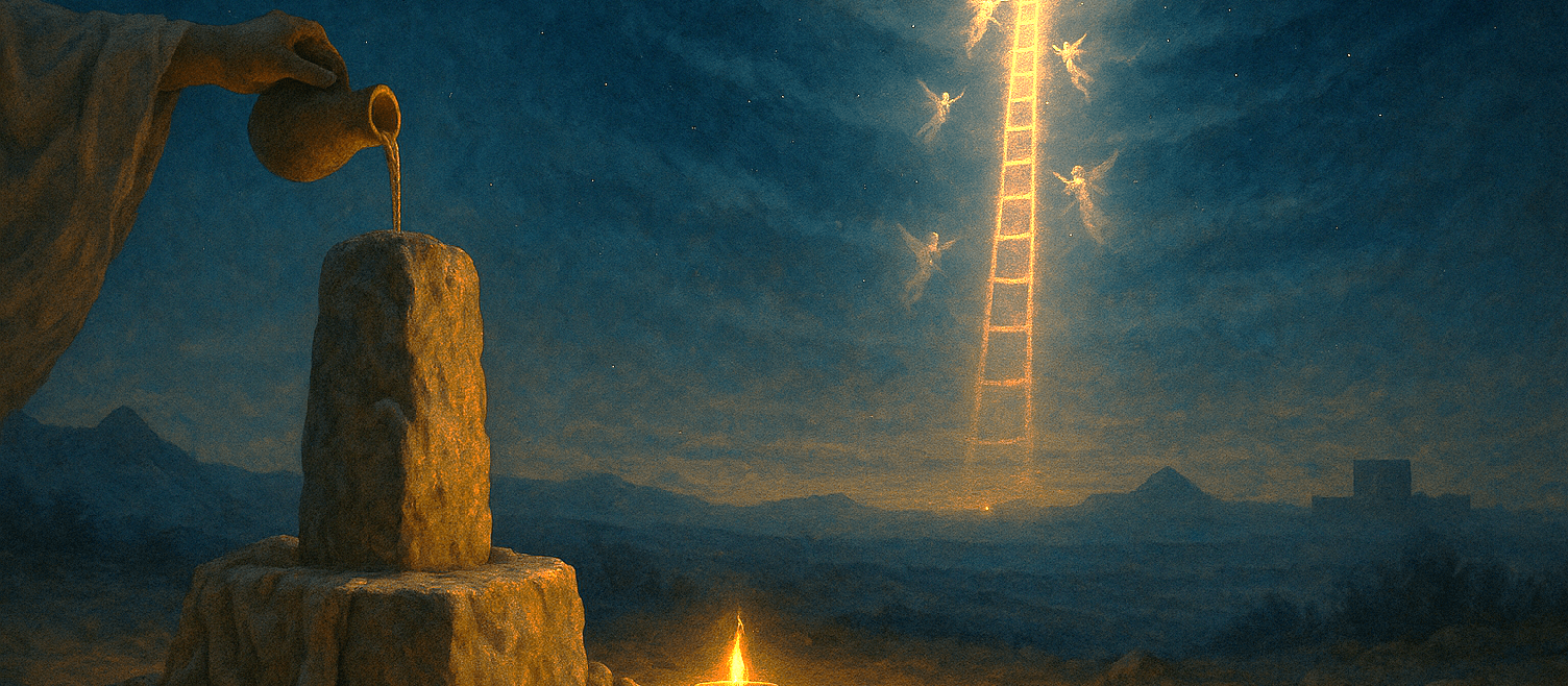
10 Now Jacob went out from Beersheba and went toward Haran. 11 So he came to a certain place and stayed there all night, because the sun had set. And he took one of the stones of that place and put it at his head, and he lay down in that place to sleep. 12 Then he dreamed, and behold, a ladder was set up on the earth, and its top reached to heaven; and there the angels of God were ascending and descending on it.
Genesis 28:13–22 (NKJV)
13 And behold, the Lord stood above it and said: “I am the Lord God of Abraham your father and the God of Isaac; the land on which you lie I will give to you and your descendants. 14 Also your descendants shall be as the dust of the earth; you shall spread abroad to the west and the east, to the north and the south; and in you and in your seed all the families of the earth shall be blessed. 15 Behold, I am with you and will keep you wherever you go, and will bring you back to this land; for I will not leave you until I have done what I have spoken to you.” 16 Then Jacob awoke from his sleep and said, “Surely the Lord is in this place, and I did not know it.” 17 And he was afraid and said, “How awesome is this place! This is none other than the house of God, and this is the gate of heaven!” 18 Then Jacob rose early in the morning, and took the stone that he had put at his head, set it up as a pillar, and poured oil on top of it. 19 And he called the name of that place Bethel; but the name of that city had been Luz previously. 20 Then Jacob made a vow, saying, “Since God will be with me, and keep me in this way that I am going, and give me bread to eat and clothing to put on, 21 so that I come back to my father’s house in peace, then the Lord shall be my God. 22 And this stone which I have set as a pillar shall be God’s house, and of all that You give me I will surely give a tenth to You.”
We’ll explore this foundational vision and four revelations that arise from it—two fulfilled, one unfolding, and one still to come.
First Revelation: HaMakom — “The Place”
Tikkunei Zohar 43 comments on Genesis 28:12: “A ladder stood on the earth and its top reached to heaven—this is prayer.”
In Genesis 28:10–11, Ya’akov reaches a “certain place” (makom). Rashi notes that “The Place” refers to Mount Moriah—the Temple Mount—where Avraham bound Yitzchak and where King Shlomo would build the Holy Temple (Rashi on Gen. 28:11). Another midrash asks why God is called Makom: “Because He is the place of the world and the world is not His place” (Yalqut Shimoni Vayetze, Remez 117).
Genesis 28:17–18
“And he was afraid and said, ‘How full of awe is this place! This is none other than the house of God, and this is the gate of heaven.’ And Jacob rose up early in the morning, took the stone that he had put under his head, set it up for a pillar, and poured oil upon the top of it.”
Second Revelation: Sinai and the Ladder (Gematria)
Rabbinic tradition links the ladder to Sinai. The Hebrew word Sinai equals 130 in gematria; so does sulam (“ladder”).
Deuteronomy 4:11
“And you came near and stood under the mountain; and the mountain burned with fire to the heart of heaven, with darkness, cloud, and thick darkness.”
Genesis Rabbah 68:12 reads the ladder as Sinai: “Set upon the earth”—Israel stood at the foot of the mountain (Ex. 19:17). “Its top reached to heaven”—the mountain burned to the heart of heaven (Deut. 4:11). The “angels of God” allude to Moshe and Aharon ascending and descending; and “the Lord stood” parallels “The Lord came down upon Mount Sinai.”
Third Revelation: Seven Heavens and God’s Dwelling
When Shlomo dedicates the Temple he proclaims:
1 Kings 8:12–13
“HaShem has said that He would dwell in thick darkness… I have surely built You a house of habitation, a place for You to dwell in forever.”
Rabbinic literature associates “thick darkness” (araphel) with the lower heavens and “house of habitation” with Zevul (one of the seven heavens). For background on “seventh heaven,” see the article linked below.
Fourth Revelation: The Messiah—Ben Yosef and Ben David
Messiah ben Yosef: “A ladder was set on the Land and its top reached to Heaven” (Gen. 28:12) is associated with Yosef (Kol HaTor 2:97). The Tzaddik “reveals prayer” (cf. Ps. 109:4), bridging heaven and earth.
Messiah ben David: Yeshua applies Jacob’s vision to himself:
John 1:51
“Amen, I tell you, hereafter you will see heaven opened, and the angels of God ascending and descending upon the Son of Man.”
Zechariah 6:12–13
“Behold, a man whose name is the Shoot… he shall build the Temple of HaShem… he shall bear the glory, and shall sit and rule upon his throne; and there shall be a priest before his throne; and the counsel of peace shall be between them both.”
Daniel 7:13
“Behold, One like the Son of Man, coming with the clouds of heaven…”
In Jacob’s ladder we glimpse perpetual communication between heaven and earth. Yeshua, the Son of Man, embodies that connection—receiving from the Father and revealing the Father’s love, obedience, and holiness to us. HaMakom seeks a relationship with each of us; Yeshua restores that relationship.
Exile and Return: Jacob as Israel’s Pattern
Jacob’s flight also foreshadows Israel’s exiles: Assyria (721 B.C.E.), Babylonia (587 B.C.E.), and the Roman dispersion (after 136 C.E.). Judah returned from Babylonia; Israel was reborn as a state in 1948; the northern tribes remain largely dispersed—not yet gathered.
Genesis 28:14
“You shall spread abroad to the west and the east, to the north and the south.”
As Jacob returned after twenty years, the prophets foretell Israel’s worldwide return.
Isaiah 43:5–6
“Fear not, for I am with you; I will bring your descendants from the east, and gather you from the west… bring My sons from afar and My daughters from the ends of the earth.”
Ezekiel 37:15–22
Two sticks—Judah and Joseph—become one in God’s hand; Israel is gathered from every nation and made one kingdom under one king.
Connect-the-Dots: Egypt, Assyria, and Israel
Isaiah 19:23–25
“In that day there will be a highway from Egypt to Assyria… Israel will be one of three with Egypt and Assyria—a blessing in the midst of the land… ‘Blessed is Egypt My people, Assyria the work of My hands, and Israel My inheritance.’”
Where Did the Oil Come From?
Ya’akov left home with only his staff (Gen. 32:10), yet he anointed the pillar with oil at Bethel. Genesis Rabbah 69:8 answers: Heaven provided oil—enough to fill a jug to its brim. G-d is good, all the time. Amen.
Attachment & Background: “In Seventh Heaven”
For a readable overview of the ancient idea of seven heavens—and how Judaism developed the concept—see Philologos, “In Seventh Heaven,” in The Forward. Read the article here.
Note: The Charles Spurgeon quotation pictured in the teaser graphic is not intended to identify the artwork; the quote is thematically adjacent to the discussion of “seventh heaven.”