

Parashah Vayeshev Comments 2023
The Torah portion (“parashah”) for this week is entitled “Vayeshev” (“He continued living”). It includes Genesis 37–40 and begins: “Ya‘akov continued living in the land where his father had lived as a foreigner, the land of Kena‘an.” This marks the opening of Joseph’s story, which culminates with his death at the end of Genesis. The narrative remains interwoven with the life of Ya‘akov until both Joseph and his father are embalmed in Egypt in Genesis 50.
Vayeshev covers Joseph’s life from age 17 through the episode two years after he interprets the dreams of Pharaoh’s cupbearer and baker. Before he is elevated to vice-regent at age 30, Joseph endures 13 years of humiliation for a crime he did not commit. By the end of this parashah, he has spent 11 years imprisoned. Chapter 38 interrupts Joseph’s saga to recount Judah’s relationship with his daughter-in-law Tamar.
Across these four chapters, the Torah shows how juvenile conceit, paternal favoritism, sibling rivalry, sexual brokenness, and unjust imprisonment become instruments in God’s plan for salvation—in this age and the age to come.
Seeds of Conflict and the Road to Reconciliation (Genesis 37)
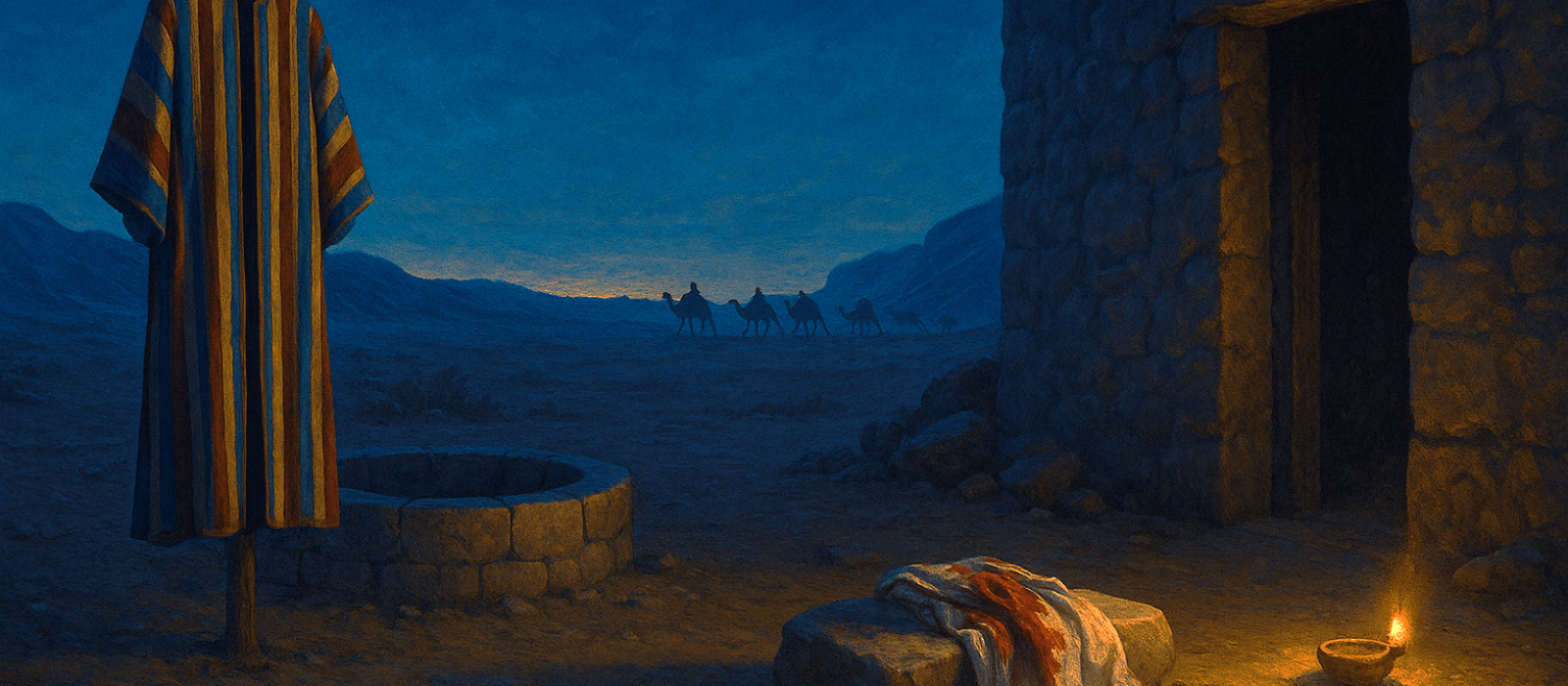
Joseph is portrayed as Jacob’s favorite son, planting the seeds for a reconciliation that comes much later. Jacob’s special affection for the firstborn of Rachel catalyzes the story: a youth who brings “a bad report” about his brothers, receives a distinctive long-sleeved robe, and—insensitively—relates two dreams in which his family bows to him. Dislike hardens into hatred and finally into murderous intent.
Reuben restrains the brothers from bloodshed, persuading them to cast Joseph into a pit. Judah then proposes selling him to Ishmaelite traders bound for Egypt. They sell him for the valuation specified in the Torah: twenty shekels for a male aged five to twenty (see Leviticus 27:5). The brothers dip Joseph’s robe in goat’s blood and present it to Jacob, who mourns his son “for many days.” Tradition counts his grief at twenty-one years, until he is convinced Joseph lives.
The chapter ends with Joseph’s sale to Potifar, a senior official of Pharaoh. As Thomas More observed, “The brethren of Joseph could never have done him so much good with their love and favor as they did with their malice and hatred.”
Judah and Tamar: Preserving the Promise (Genesis 38)
The narrative pauses to recount Judah’s house. Judah’s sons—Er, Onan, and Shelah—become entwined with Tamar through levirate marriage. Er dies; Onan marries Tamar but withholds offspring and dies; Shelah is withheld from her. Tamar, discerning the stakes for the covenantal line, veils herself and secures offspring from Judah himself. When confronted, Judah declares, “She is more righteous than I,” and Tamar bears twins—Peretz and Zerah—securing the line that will yield King David and, for Messianic readers, Messiah Yeshua.
“I will most certainly bless you; and I will most certainly increase your descendants… and by your descendants all the nations of the earth will be blessed…”
Sarah, Rebecca, Rachel—and here, Tamar—embody a faithful persistence that guards the promise. Was Tamar’s act impatience or providence? Either way, God wove it into His will.
Joseph in Potifar’s House (Genesis 39:1–18)
Joseph prospers because the Presence is with him. Potifar recognizes that everything entrusted to Joseph flourishes. Only Potifar’s wife is withheld. Her repeated advances and Joseph’s refusal precipitate a false accusation. Some suggest Potifar suspected the truth; rather than execution, Joseph is imprisoned—yet even in chains, blessing follows him.
“Adonai was with Yosef… Adonai prospered everything he did… Adonai blessed the Egyptian’s household for Yosef’s sake… Adonai was with Yosef… and whatever he did, Adonai prospered.”
Dreams in the Dungeon (Genesis 40)
In prison, Joseph attends Pharaoh’s chief cupbearer and chief baker—colleagues within Pharaoh’s court. Each dreams of “three”: branches and baskets. Others see separate symbols; Joseph discerns days. On the third day—Pharaoh’s birthday—one is restored and one executed. Joseph appeals to the cupbearer to remember him, but he is forgotten… for now.
Providence in the Pattern
Coincidence or choreography? From a blood-stained robe to a prison’s lamplight, God’s design threads through human sin and sorrow. As Joseph will later tell his brothers, what was meant for evil, God meant for good.
“Furthermore, we know that God causes everything to work together for the good of those who love God and are called in accordance with his purpose.”
Heart Application
There are two kinds of people: those who say to God, “Thy will be done,” and those who say, “My will be done.” Tamar and Joseph stand as bricks in the wall of God’s unbreakable promises. Abraham’s greatest treasure was not wealth but friendship with God—the “pearl of great price.” To possess the kingdom is to yield ourselves wholly to the King.
“A person may plan his path, but Adonai directs his steps… Better a little with righteousness than a huge income with injustice…”
Always Remember
God loves you as you are. God knows what is best far better than we do. Place your trust in Him; He will not forsake you.
“Then God’s shalom, passing all understanding, will keep your hearts and minds safe in union with the Messiah Yeshua.”
B’shem Yeshua HaMashiach,
Ormein