
Parashah Pekudei Comments 2024
To understand this teaching, you will need to know a few things about the written Hebrew language and “Gematria.”
Gematria interprets Hebrew words and phrases by attaching numerical values to letters. Hebrew, as written in the Holy Scriptures, is made up of consonants; the sacred texts historically did not include vowels. The reader supplied the vowels from context, so it is only the consonants that carry numerical significance.
Masoretes and Vowel Pointing
The word “Masorah” in Hebrew means “tradition.” The Masoretes—Jewish scholars active roughly between the 6th and 10th centuries C.E.—preserved and transmitted the sacred text to future generations. Their major contribution, coming long after the Septuagint (a Greek translation of the Hebrew Bible, 3rd–1st c. B.C.E.), was the system of vowel pointings, which guided pronunciation and clarified meaning.
Gematria was developed and systematized by medieval Jewish mystics and used to gain insight into Hebrew words and phrases. When the Masoretes later standardized vowel pointing, it further enhanced careful study of Scripture and, for some, the usefulness of Gematria.
Some dismiss Gematria as merely “playing with numbers,” while others find it helpful—especially when wrestling with difficult or obscure passages. Here is a classic example.
Pekudei and the Completion of the Work
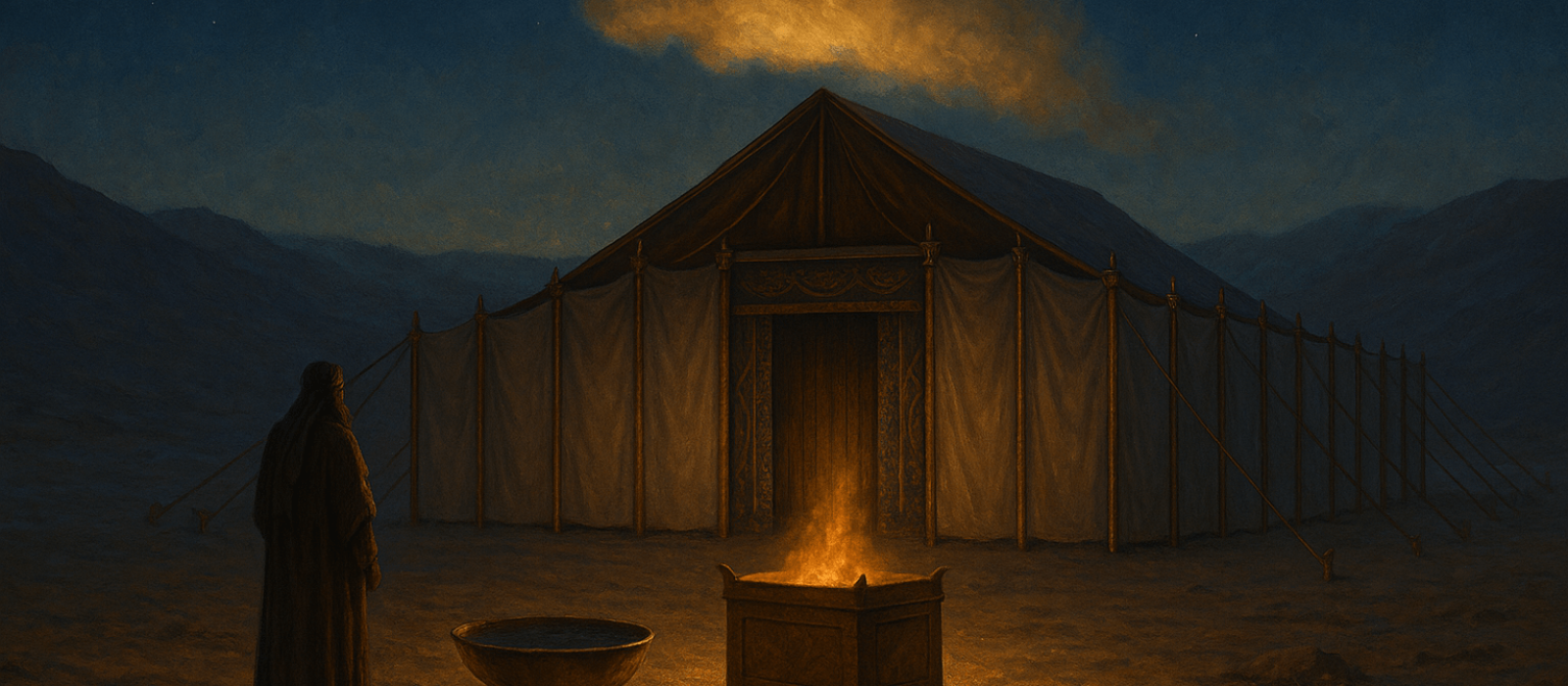
The final portion of Exodus, Pekudei, details the building of the Tabernacle (Mishkan), its furnishings, and the special garments of the priests. It culminates with a striking line:
According to Gematria-based comparisons, the value of this phrase corresponds to the opening words of Scripture:
This parallel suggests that creation itself aimed toward the unveiling of God’s dwelling among His people—the Tabernacle—and, by extension, toward the revelation of God’s redemptive love to all creation.
Messiah from the Foundation of the World
The Talmud affirms a similar cosmic focus:
Thus, the Torah, the Tabernacle, and the Messiah are inextricably linked.
1 Peter 1:20 — He “was foreknown before the foundation of the world…”
Ephesians 1:4 — “In the Messiah He chose us… before the creation of the universe…”
2 Timothy 1:9 — Grace “given to us… before the beginning of time.”
Creation, then, finds its end (its goal) in God’s redemptive love—manifest in Yeshua HaMashiach, the Lamb of God, the Aleph and the Tav, the Beginning and the End.
Revelation 1:17 — “Fear not, I am the first and the last.”
“Emet” — The Seal of God
Jewish sages teach that “the seal of God is truth.” The final letters of the last three words in the creation account—bara Elohim la’asot (Genesis 2:3)—form the letters aleph, mem, tav: emet, “truth.” The phrase “God created to do” implies that God completed His creative (and, in purpose, redemptive) work by the end of the sixth day, inviting us to enter His rest.
Jewish Contexts in the First Century
The Tanakh is a Jewish document; the New Testament is, too. Many first-century Jews came to faith in Yeshua through the Scriptures they already knew, illuminated by the Spirit, long before the New Testament canon was fully recognized. Rabbi Itzhak Shapira’s work (The Return of the Kosher Pig) highlights ideas that were part of the Jewish theological conversation two millennia ago.
Midrashic note: Some associated chen (beauty/grace) with Messianic expectation; politics of the era could “spin” outward appearances and obscure the Beautiful One.
Orthodox teaching often emphasizes that Israel must be prepared to welcome Messiah. The growth of Messianic communities worldwide can be seen as part of that preparation—signposts that help “connect the dots” for those whom God is awakening.
Paul’s Damascus encounter was received within a richly Jewish context—he was trained by Rabban Gamliel. Many embraced Yeshua because it harmonized with Jewish thought; many others did not, largely due to the politics of the time.
Jewish mystical literature (Zohar) speaks of divine emanations; some see binah (understanding) as a compound hinting at “ben” (son) and “Yah.” While not Scripture, such discussions were part of the wider Jewish spiritual dialogue in Yeshua’s day.
Relatedly, an older Jewish concept divides Messianic history into four phases: before His birth; birth to death; death to resurrection; and resurrection to return. The Messiah’s death, resurrection, and return are therefore not foreign to Jewish thought.
Yeshua identifies Himself with the Temple—the living meeting place with the Father—much as the Mishkan and later the Temple were the locus of God’s dwelling among His people.
The Mishkan as a Microcosm of Creation
The Creation narrative spans two chapters; the Tabernacle’s construction spans dozens. Yeshua can be discerned throughout, if you have eyes to see. The Mishkan was the communal place of worship, a tangible assurance of God’s Presence journeying with Israel from Sinai toward the Land of Promise. It was both an expression of the Creator and a vibrant sign of His covenant: “You shall worship Me alone, and I will grant you peace now and forever.”
The Mishkan proceeded from God to creation, to Israel, and concentrically toward the Holy of Holies where God’s throne—the Mercy Seat atop the Ark—rested. In this way, building the Tabernacle mirrors the ordering of creation itself.
Genesis says God “finished” His work and rested; Exodus says Moses “finished” the work of the Mishkan. The Hebrew la’asot (“to do/make”) binds the creation account and the Tabernacle narrative. God’s work is complete; Moses’ work reaches completion; and in purpose both culminate in Yeshua—the One whom Moses and Elijah discussed at the Transfiguration.
Exodus closes with God’s palpable Presence guiding Israel. Thus the long absence felt in bondage ends with the nearness of the Redeemer, moving His people toward promise.
Chazak, Chazak, V’nitchazek!
As we conclude Exodus we proclaim, “Chazak, chazak! V’nitchazek!”—“Be strong! Be strong! And be strengthened!” May we delight in God’s Word, be faithful representatives of His Kingdom, and prepare the world for the return of His Messiah.
Amen.