
1720 AM (2040 BCE) – Shelach and the Tower of Babel
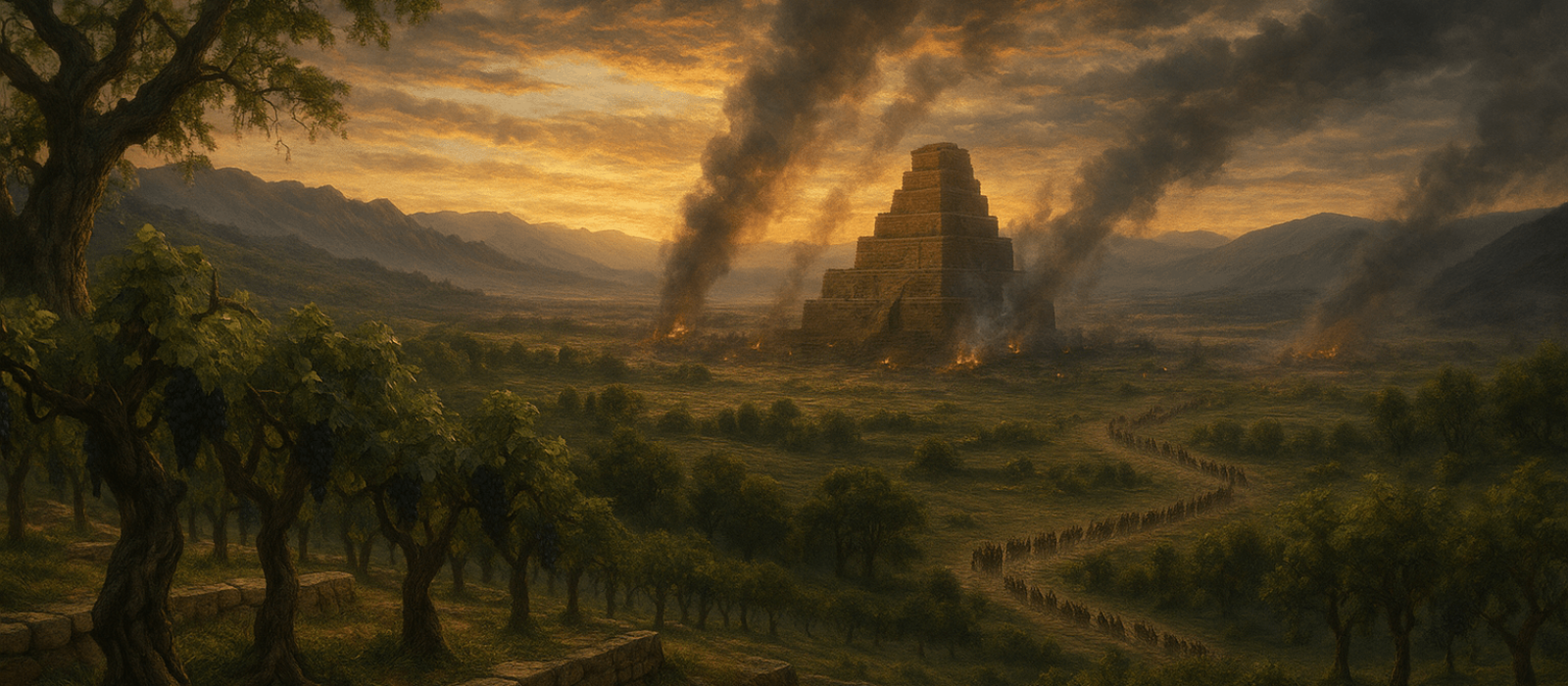
Shelach was in his grandfather Noah’s vineyard. From that vantage point, he could still see far down into the distant valley below, even though the vines were overgrown and loaded with many bunches of grapes. Shelach remembered what it looked like when he was a child. Oh, how the valley had changed!
None of the other families from Ham or Japheth really stayed up here in the mountains—just those from the family of Shem. Everyone else lived down in the valley. Japheth was in the northern part of the valley, and Ham settled mostly in the south. But even still, they seemed stacked on top of each other like those horribly hideous bricks that Mizraim was teaching everyone to make from straw and clay. As if anything good would come out of those things.
Shelach again peered out, but this time to the distant horizon, as he had done when he was with his grandfather as a child. He could now see vast areas of fertile valleys and grazing places where only a rocky clag of a wasteland had been visible. Shelach looked at the beautiful lakes that had formed in just his short lifetime, along with migrating flows of… of… well, they were very large. Shelach thought Noah may have just called them Behemoth.
The earth was now teeming with food and water and life, yet word was getting back to Shelach from the valley that people were actually going hungry, not having enough to eat. They were required to travel farther and farther to hunt, and they would also have to vary what they were planting, because the soil would stop producing. Moreover, the wells could not support the population as such, and they would have to be continuously dug deeper and farther away.
And then the blasphemy started—the accusations. “Didn’t El say the land would always yield?” or “Didn’t El say there would be water?”
And when Shelach tried to answer, “But Adonai said to fill the earth, not just one single valley!” the people would answer, “Who made you judge over us?”
And so, on it went.
Some people, like families of Phut and Canaan, said that El could provide as He had promised—if He wanted to—but that El didn’t love us enough to give us what we wanted when we wanted it. This nonsense resonated with many, and all Shelach could think was, “My God, Adonai, it is happening all over again.”
It was, in fact, Canaan who suggested the way to get El’s attention was to build a tower. This tower would channel the divine spark of the Creator, and then Canaan could force El to fulfill His side of the covenant, and the people could live in security knowing that Canaan was at least watching out for them. This tickled the ears of many, and many began work on the tower, using the Mizraimite bricks.
This did not, however, in any way tickle the ears of the descendants of Shem, and they met with Shelach to discuss the heresy. What they were doing was disobedient, vile, blasphemous, and wicked. This is not what Adonai wanted. Besides, to refer to Adonai as El, after all this time? Did they have no reverence for His Name? It was so crass!
They all agreed that they would have to prepare to leave the mountain and the valley by the next full moon. They did not want to be around to expose their children to that wickedness. What else could they do?
And besides… Sorry, what? What was that? What did you say? Hello? You are babbling. Say that again… Suddenly, everyone stopped talking, and an eerie silence filled the room. Shelach could not understand what those from the family of Aram were saying, and Elam could not understand what the family of Lud was saying. The descendants of Shem realized that something most terrible had happened—something by the hand of Adonai. A judgment against the tower that was being constructed in the valley far below.
The next morning, the leaders of the families of Shem met together in the vineyard and looked down into the valley far below. It was utter chaos. Much of the settlement was on fire. The cries of fear and sorrow and pain could just be heard all the way up in the high hills.
The family leaders of Shem observed large caravans moving both north and south. It looked as if most of Ham’s families were headed south, while most of Japheth were headed north. By the next full moon, only the tiniest remnant remained anywhere near the valley of the abandoned Tower of Babel.
Used with permission by the author. Find the author’s complete works online: Complete Works of Mack Samuels